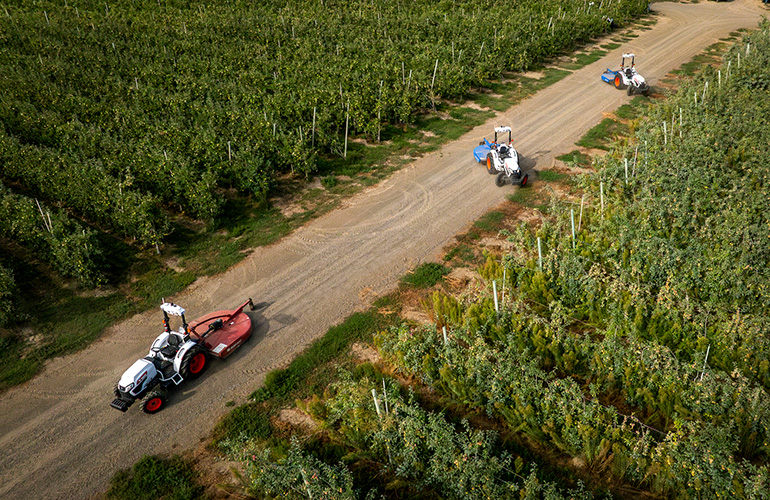
Off-road physical AI company Agtonomy has expanded its commercial platform with fully autonomous multi-point turning and enhanced passive data collection. The company said this enables farm equipment to execute complex maneuvers in tight headland spaces without human intervention.
Agtonomy develops full-autonomy packages that retrofit vehicles from its OEM partners, Kubota and Bobcat. These platforms are key to growers and farmers with smaller operations, said the South San Francisco-based company.
For physical AI devices, data is key to the evolution of the system. Each Agtonomy vehicle in operation processes more than 2 terabytes of data per vehicle, per hour, generating a continuous stream of field intelligence for the commercial autonomy platform. This data is captured across diverse operating environments, equipment platforms, and tasks. Agtonomy said It supports faster iteration, stronger system performance, and continued advancement of practical automation for rugged off-road applications.
Multi-point turning now available #
Within orchard and vineyard operations, space is tight. The capability to perform accurate and safe multi-point turning will enable more precise operation, said Agtonomy.
Farm equipment can use its system to execute complex maneuvers in reverse with precision, without any human intervention. Designed for real operating conditions, the feature helps autonomous tractors complete tasks on acreage that was previously inaccessible due to space constraints. This addition marks another step forward in full task automation, not just isolated vehicle movements.
“Growers don’t have time to wait for innovation to show up in the field; they need autonomous fleets that work today and get better tomorrow,” said Tim Bucher, co-founder and CEO of Agtonomy. “That’s what’s driving us: a continuous loop between real commercial operation feeding real product development that lets us solve real problems, like tight headlands or inconsistent data collection, faster than the industry is used to.”
“Agriculture is where we started, because it’s one of the most critical industries on the planet, but the same approach is what will carry this platform into every rugged, off-road environment that can’t afford to be an afterthought when it comes to innovation,” he added. “We’re moving at the pace our customers actually need and putting that value back into the hands of the people doing the work.”
Agtonomy moves from field data to fleet-wide intelligence #
Beyond improving autonomy, Agtonomy said the anonymized data collected passively by autonomy-enabled units is forming a growing foundation of real-world model data across equipment, tasks and operating environments. Over time, it said this data foundation will support new applications for customers and partners.
The data can also be made available to qualified ecosystem partners, such as agronomy and analytics providers. Agtonomy said it can lead to agronomic insights, operational analytics, fleet optimization, and other data-driven services.
“Agtonomy has completely changed the way we approach data collection in the orchard,” said Joel Carter, orchard operations manager at Okanagan Specialty Fruits. “We now use Agtonomy-enabled equipment for 100% of our crop data collection jobs. It can operate around the clock, including at night, covering every row at a consistent speed without requiring manual data collection.”
“The data we collect supports yield counts, crop canopy management, and other key orchard insights,” he said. “That consistency and accuracy have helped us improve fuel efficiency, reduce the labor and cost required for data collection, and collect more precise, repeatable data across our operation.”
Agtonomy has also continued to expand the versatility of its platform, which now supports more than 500 implements across a wide range of field tasks. These range from large-capacity air blast sprayers and ground-engaging discs to precision toolbars and other specialized equipment, each with different operating requirements and precision-control behaviors.
To support this breadth, the company has developed the Agtonomy Implement Library, which is designed to provide a standardized way to integrate new implements and configurations into the platform.
To learn more about the latest in ag robotics and physical AI devices deployed outdoors, sign up for the upcoming webinar on “Field Robotics in Agriculture, Energy, and Construction” on Sept. 16 at 12:00 p.m. ET. The panel features Nic Fischer, chief technology officer at Agtonomy; Vibhor Sood, co-founder and vice president of engineering at Burro; and Connie Bowen, founding general partner at Farmhand Ventures.