Introducing Agora-2: Advancing Multi-Agent World Simulation Our next-generation multi-agent world model, supporting up to 20 humans and agents inside a shared world simulation
Oliver Cameron
September 21st, 2026
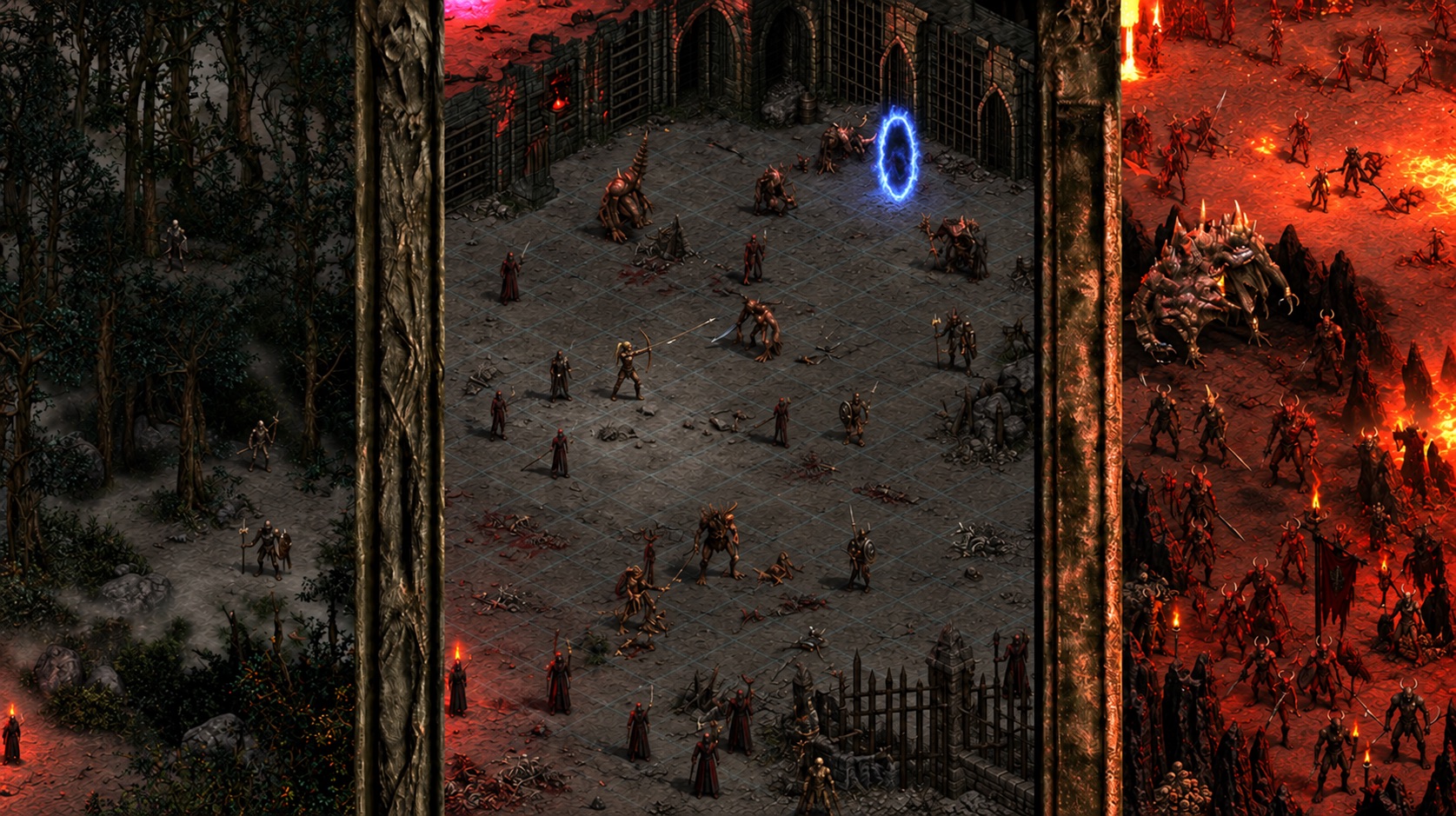
Today we’re excited to release a playable research preview of Agora-2, our next-generation multi-agent world model that generates shared, interactive environments in real time for up to 20 humans and agents. Agora-2 supports 5x more participants as Agora-1, while expanding from being capable of simulating a single environment to multiple environments, featuring more complex interactions and longer-horizon behaviors.
To explore these richer multi-agent interactions, we turned to Diablo II, developed by Blizzard. Games have long served as a useful environment for AI research, providing worlds in which agents can learn through interaction with their surroundings and one another. We’ve trained Agora-2 on captures from Diablo II that pair observations with actions and state, allowing the model to learn how entities navigate, interact, and respond to one another.
In effect, Agora-2 functions as a learned game engine, allowing humans and agents to interact within the same generated environment, with each participant’s actions influencing the shared simulation and the experiences of others within it. You experience our playable research preview of Agora-2 today.
Going forward, we believe multi-agent world models will increasingly power important applications across AI training, robotics, autonomous vehicles, defense, energy, cybersecurity, and gaming. Recent reports of AI-powered cyberattacks and collusion between agents also make understanding how AI systems interact with one another an urgent research priority. Although still nascent, multi-agent world models offer a path to study and improve these interactions within controlled simulations, where harmful behavior can be investigated without exposing real-world systems to risk.
Simulating in Real-Time
A World Simulation That Humans and Agents Can Share #
Agora-2 generates a shared world simulation—in the form of streaming pixels—in which humans and agents can interact in real time, with each experiencing the consequences from their own perspective. Whereas a single-agent world model like Odyssey-3 simulates one participant’s experience, Agora-2 maintains an explicit shared state that accounts for multiple participants’ actions and their effects on one another. We introduced this architecture in Agora-1, and have extended it in Agora-2 to support more complex interactions over longer periods.
Agora-2 Predicts How Participants Affect One Another #
Agora-2’s simulation model is trained to predict how the combined actions of participants change shared state, drawing on each entity’s properties, recent actions, and surrounding geometry. Attention across these representations allows the model to account for the relative arrangement and behavior of other participants when predicting an action’s consequences.
The world server then combines the simulation model’s predictions to update the shared state, which gives every participant’s rendering model the same account of everything that’s happening, all in real time. Because entity properties are retained in this state independently of any particular view, they remain available when an entity is out of frame, and do not have to be reconstructed from that participant’s visual history when it reappears.
Each Participant Experiences the Same Simulation From Their Own Perspective
Once shared state has been updated, the rendering model generates each participant’s view from their perspective, using a compressed visual representation. It is conditioned on the shared environment, the entities involved, and the effects of their interactions, while each participant’s recent visual history provides a reference for their appearance and helps maintain visual continuity as the state changes.
Agora-2 Simulates in Real-Time #
We train the rendering model with flow matching to learn from sequences with varying levels of visual noise. During training, we frequently remove visual history so the rendering model has to rely on the supplied state to depict the simulation. We also place greater weight on errors involving entities, helping the model learn to represent the participants whose actions drive an interaction.
During simulation, each newly generated view becomes part of the visual history used for the next update, completing a continuous loop between participants’ actions, the simulation model, and the rendering model. Our technical report describes the architecture, training, and serving system in more detail.
Towards Agents and Simulations That Learn Together #
We train agents using reinforcement learning to pursue opponents, navigate around obstacles, and recover when they become stuck or separated. These agents must learn to do this from a partially observed view of the world, using recent observations to track nearby participants and adapt as the situation changes. We're expanding on this research topic with PROWL, exploring how agents can learn intelligent behaviors inside world models and how their experiences can improve the world, allowing agents and the environments that train them to become more capable together.
Towards Agents and Simulations That Learn Together
We see a clear path to bringing multi-agent interaction into foundational world models like Odyssey-3, extending shared experience across the many environments these models can simulate. This means learning representations that can describe unfamiliar entities, actions, and relationships while preserving the open-ended behavior of a foundation world model.
How Coordination and Competition Shape Learning
With multiple agents making their own decisions, there is a limit to how much we can teach through recorded demonstrations, and a great deal for them to learn through direct interaction. As we described in The Era of Multi-Agent Imagined Experience, coordination and competition offer a source of curricula that develop alongside the agents themselves, as improvements in one agent change what the others must learn to handle. Failures uncovered during those interactions also provide training data for the world model, following the approach developed in PROWL.
Learning to Act in a World Shared With Others #
In robotics, autonomous vehicles, defense, energy, and cybersecurity, an agent’s success can depend on decisions made by other participants, often with different information and competing objectives. Robots working with other robots and humans must coordinate their actions to accomplish complex, long-horizon tasks, while defensive cyber agents have to protect legitimate activity against attackers whose strategies continue to evolve.
Multi-agent world models will let us train these systems together, with agents learning through cooperation and competition as the capabilities of those around them improve. Our ambition, described in our Odyssey-3 announcement, is for their experiences and discoveries to improve the world models that train them, allowing the agents and their simulated environments to become more capable together. Agora-2 is a big step in this direction.
You can experience our research preview Agora-2 today, and see how your decisions shape the experience of humans and agents inside the same world simulation.