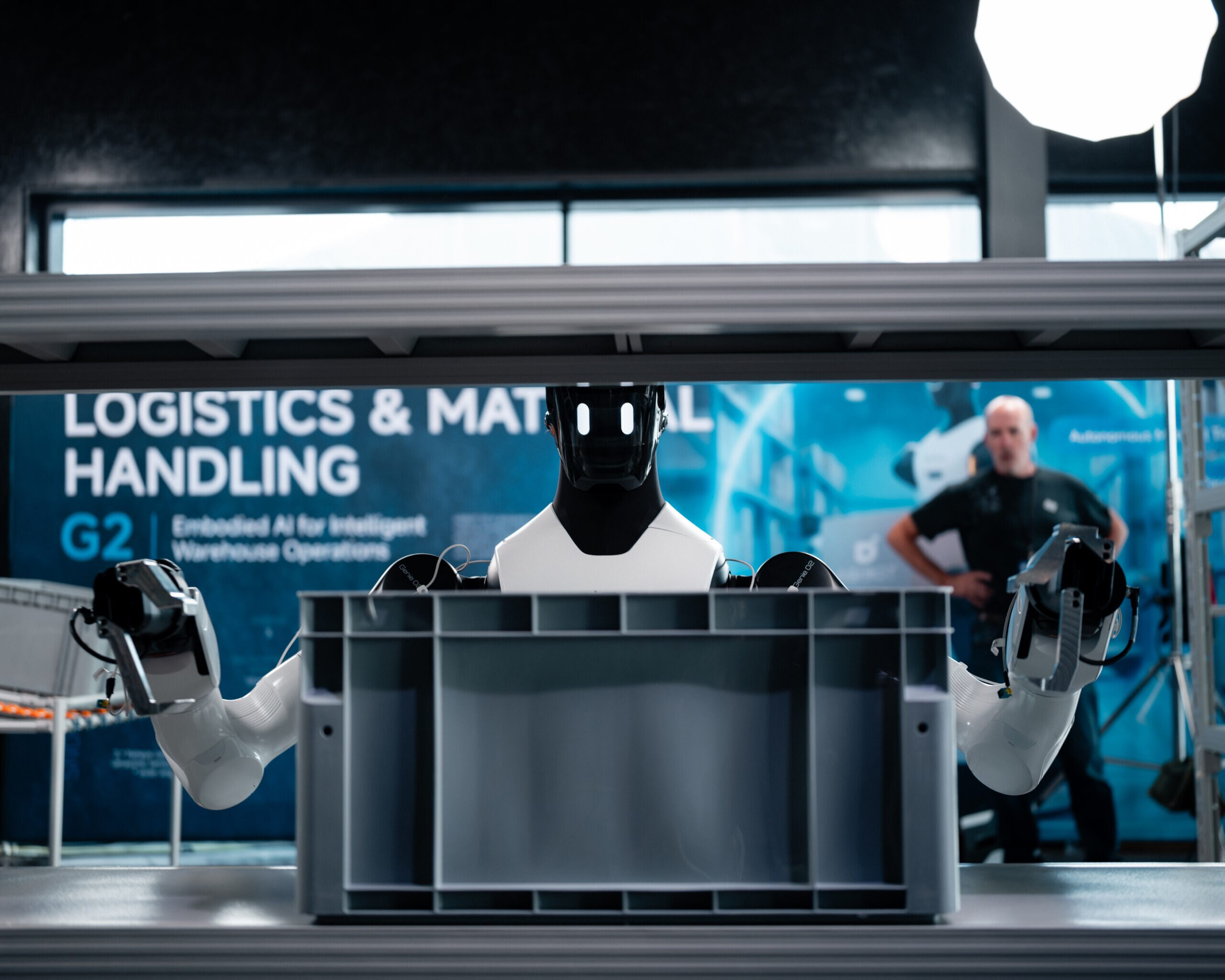
Until recently, much of robotics was largely defined by demonstrations of what machines could do. Today, the industry is rapidly shifting towards real-world deployment, with humanoid, quadruped, and other autonomous robots beginning to perform practical tasks across manufacturing, logistics, warehousing and other industrial environments. AGIBOT’s recent Partner Conference in London, UK, demonstrated how quickly that transition is happening — and why the next challenge is no longer just about building more capable robots, but building robots that can scale.
Industries such as transportation, manufacturing, logistics, healthcare and hospitality are among the first sectors to benefit from new intelligent autonomous machines. This topic was a key discussion point at the AGIBOT Partner Conference where I joined leaders from AWS, NVIDIA and Oxford Robotics Institute on a panel to explore how robotics is moving from research and development into real-world deployment.
Scaling robots requires a common compute foundation #
Just three years after being founded, AGIBOT has evolved from early demonstrations to deploying robots in industrial environments, reflecting how quickly physical AI is maturing from proof of concept to commercial reality.
Before a robot enters the real world, models need to be developed, tested and refined. Then, once deployed, intelligence must run close to the sensors, motors and control systems in real time, while fleets require continuous software updates, data feedback loops and ongoing optimizations.
Scaling physical AI requires a common compute foundation that spans the entire development lifecycle — from cloud-based AI training and simulation through to edge deployment, fleet management and continuous software updates. This becomes even more important as the industry develops and deploys world models that can help robots better understand, predict, and respond to changing physical environments. These models require vast amounts of compute across every stage of the lifecycle, making efficient cloud-to-edge compute more critical than ever.
Balancing compute with real world constraints #
The natural response to building increasingly capable robots for the real world is to add more AI models and more performance. But that’s only part of the answer, especially for robots to scale effectively.
Every robot operates within strict physical constraints. Battery capacity is limited. Cooling is limited. Weight is limited. More AI cannot come at the expense of runtime, efficiency or mobility.
The challenge isn’t simply adding more TOPS — it’s running increasingly sophisticated AI workloads more efficiently across the entire robotic system. For example, a humanoid robot needs to process sensor data, run AI workloads, coordinate motion and respond in real time, while staying within strict battery, thermal, weight and mechanical limits.
A robot cannot treat intelligence as a separate workload. Perception, decision-making and actuation must operate together in real time, with deterministic latency, energy-efficient compute and safety-capable systems that can support AI inference and control simultaneously.
As Drew Henry, EVP of Arm’s Physical AI Business Unit, described in the Robot Report podcast, “This is a space where the time between sensing the world and triggering action becomes one of the defining engineering challenges.”
Co-designing compute platforms alongside physical AI workloads #
AGIBOT’s robotics platforms – covering humanoids and quadrupeds – demonstrate how AI workloads and compute architecture increasingly need to be co-designed. From sensing and perception through reasoning, motion planning and actuation, every stage depends on hardware and software working together efficiently.
Arm has provided platforms for automotive, autonomous vehicle and robotics solutions for more than a decade. In 2025, the ecosystem shipped two billion Arm-based chips into these areas. The Arm compute platform spans the entire robotics system — from low-power sensor processing and deterministic real-time control to high-performance central compute — giving AGIBOT a consistent foundation across the system. This makes it easier to deploy AI workloads while balancing performance, efficiency and responsiveness.
Arm also provides architectural continuity for the physical AI ecosystem, allowing developers to train models in the cloud, validate them through simulation and deploy them to robots running on the same underlying architecture. As new robot generations emerge, software portability helps engineering teams build on existing software investments rather than rebuilding foundational components.
As AGIBOT looks towards its next generation of robots, the focus is on packing more compute and AI processing into humanoid systems without exceeding the limits of batteries, thermals and software complexity. Working with Arm helps address these compute challenges at the platform level, supporting robots that can sense, move, interact and scale in the real world.
Scaling the future of physical AI #
As robots become practical tools across transportation, logistics, manufacturing, healthcare and hospitality, the companies that succeed will not simply have the most capable AI models; they will have the compute platforms that allow these models to operate efficiently, safely and at scale.
AGIBOT’s rapid progress demonstrates that the era of commercially deployable physical AI is beginning. By providing a common compute platform that spans cloud development, edge AI and real-time robotic systems, Arm is helping build the foundation that will enable the next generation of physical AI.
Advancing AGIBOT robotics with Arm technology
Learn how AGIBOT uses the Arm compute platform to deliver high-performance, energy-efficient intelligence across its robotics platforms.
Any re-use permitted for informational and non-commercial or personal use only.