Agentic robotics — using LLM coding agents to write and debug robot programs instead of pouring ever more human demonstrations into imitation learning — is the pitch UC Berkeley and NVIDIA took to the 2026 Conference on Robot Learning (CoRL) this week. IEEE Spectrum's November 9 feature by robotics editor Evan Ackerman quotes Berkeley's Ken Goldberg and NVIDIA's Spencer Huang on why factories may need code scalability, not just data scalability, and reports simulated industrial tasks hitting up to 99% success where imitation baselines lingered near 20%.
The headline is not a shipping product. It is a research direction with benchmarks and partner anecdotes — but it matters because it reframes how general robotics might borrow the same agentic coding wave reshaping software teams.
Why imitation learning hit a reliability wall in factories #
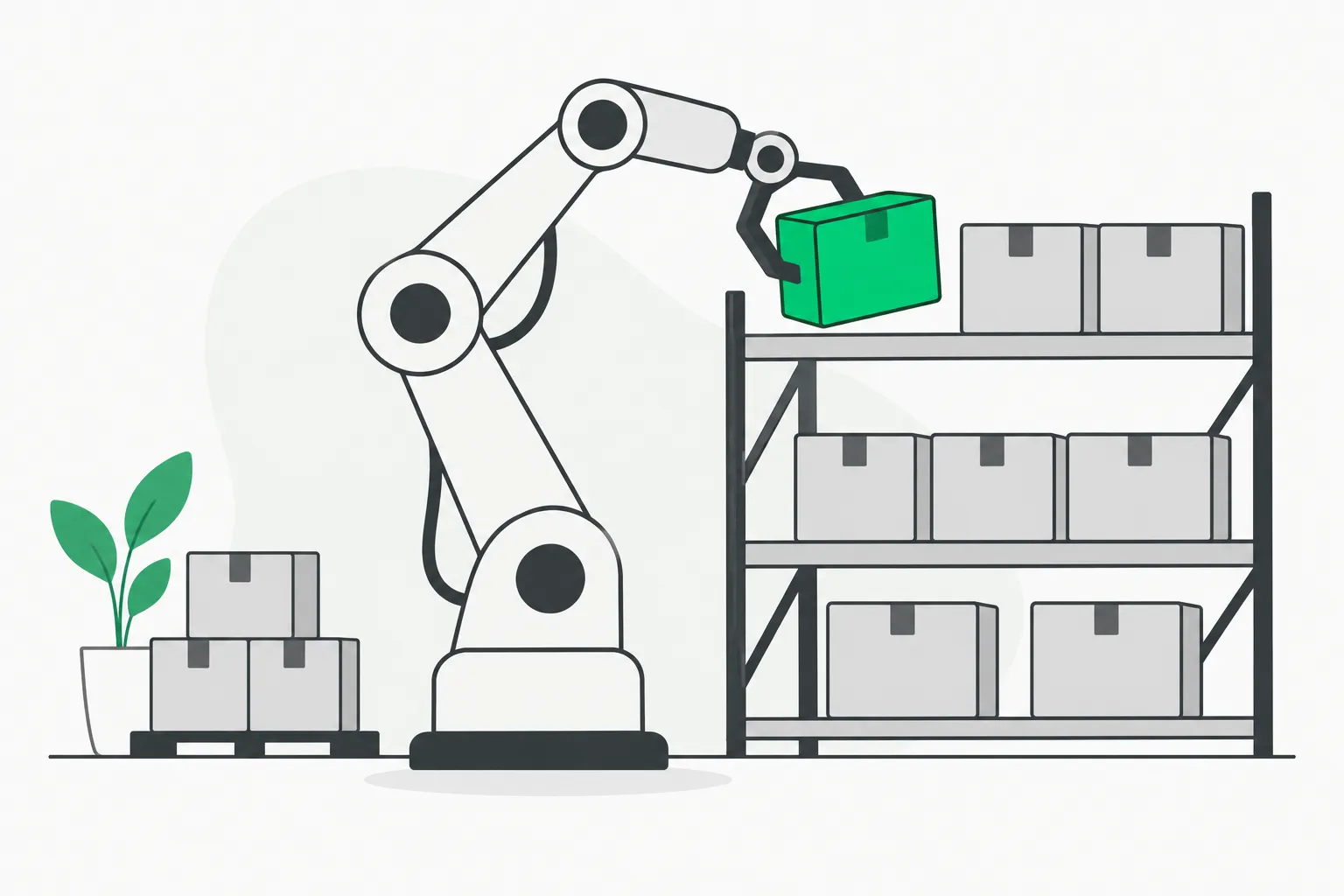
Industrial robot cell where imitation-learning reliability plateaus on repeat tasks
Goldberg tells Spectrum the imitation learning paradigm has hit a plateau for industrial work. Home robots tolerate occasional failure; lines at Ambi Robotics (which Goldberg co-founded) or partners like Siemens and Bosch cannot.
The usual loop: collect demos, train a policy, deploy, watch edge cases fail, collect more demos. Goldberg says teams keep hoping more data will trigger a ChatGPT-like phase transition. Investors funded data-collection startups on that bet. Spectrum's framing: "everybody's getting a little nervous" that convergence has not arrived.
That anxiety sits next to humanoid hype — Yann LeCun's skepticism on human-level embodied AI and NVIDIA GR00T-style platforms chase different axes. Agentic robotics targets arm cells and precision placement first, not living-room helpers. Related open work includes CaP-X, a framework for benchmarking coding agents on robot manipulation, with Goldberg among its authors.
How coding agents replace the data treadmill #
Huang and Goldberg argue robotics already has decades of libraries: object classifiers, pose estimators, motion planners, trajectory generators. The bottleneck was a human writing glue code. Agentic coding quality in 2026 makes autonomous write-test-fix loops viable.
A grocery-packing example in Spectrum splits work across agents:
- Perception agent — find items and bag.
- Manipulation agent — gripper trajectories.
- Transport agent — arm motion between poses.
Agents run code in simulation, tweak failures, and iterate — like a junior roboticist with infinite patience. Output is human-readable Python or C++, not an opaque policy net — important for audits on a factory floor.
Huang notes adversarial setups: one agent proposes a program, another hunts flaws — a mirror of how teams use critique passes in coding agent sandboxes.
Simulation matching from video — and the sim-to-real gap #
Sim-to-real transfer from a dotted simulation tray into a deployment workspace
Goldberg describes feeding an agent video of the real cell and asking it to tune simulation parameters until render and reality align. Spectrum quotes him saying lighting, backgrounds, and tedious calibration matched well enough that staff struggled to tell which feed was which.
Torsten Kroeger of Alphabet's Intrinsic (not affiliated with the Berkeley paper) cautions in the same piece: no physics engine fully models contact-rich manipulation. That is the enduring sim-to-real gap. Agentic loops can still help by revising code and sim params when real runs fail — but Kroeger warns about trust without human review, echoing broader AI agent alignment debates.
Industrial numbers Spectrum cites #
Manufacturing assembly line where coding agents target sub-millimeter placement tasks
IEEE Spectrum reports Berkeley experiments with up to 99% success on some industrial manipulation benchmarks in simulation, versus ~20% for imitation learning baselines on the same tasks. Treat that as lab metrics on selected tasks, not a warranty for your line.
Huang's near-term target is sub-millimeter placement — semiconductor partners mentioning 0.3 mm tolerances where humanoid stacks like GR00T are not yet repeatability-ready. The Wistron anecdote: 8+ hours to retask a robot on a new GPU board versus one to two minutes with agentic retasking in their telling.
That is the business case: mixing SKUs faster than hand-tuned teach pendants, not winning viral demo videos.
NVIDIA's benchmarking layer #
NVIDIA is packaging evaluation via Isaac Lab-Arena and the Newton physics engine so research groups can score agent-written controllers consistently. That parallels how NVIDIA markets Dynamo recipes for open models on the software side — tooling to compare runs, not just blog claims.
Huang also argues agentic robotics can emit training data of its own: high-quality programs become supervision for the next generation of policies. Whether that closes the loop or just shifts the bottleneck is unsettled.
What builders should watch #
If you deploy manipulation cells or maintain ROS / MoveIt / proprietary stacks:
- Pilot coding agents on sim first with adversarial review, especially on contact-heavy steps Kroeger flags.
- Treat generated code like any other CI artifact — versioned, reviewed, signed.
- Compare retask time on one real SKU before betting the line.
If you train foundation robot models, agentic robotics is competition to pure scaling — and a source of structured programs you might distill. Home humanoids remain a different lane; see open HumanWAM datasets for where data scaling still dominates research.
Safety, review, and the alignment objection in factories #
Intrinsic's Torsten Kroeger is not dismissing the idea — he is naming the physics gap and the governance gap. Factory safety officers already sign off on deterministic PLC code; agent-generated motion plans reintroduce version skew unless your change-control process treats agent output like human intern commits.
Practical mitigations Spectrum's sources imply:
- Human review before deploy on every generated controller, with diff against last known good.
- Adversarial agent pairs inside sim before hardware moves (Huang's stated pattern).
- Formal limits on joint speeds and workspace envelopes that agents cannot override without another approval step.
None of that is novel security tooling, but it is how coding agent sandboxes lessons transfer to shop floors. If your company runs Meta Project OT-style experiments, treat robot agent code as OT software with network segmentation.
Where agentic robotics sits next to foundation-model stacks #
NVIDIA still markets GR00T and humanoid narratives; agentic robotics in this story is not replacing those demos. It is the boring middle: placement, kitting, board handling — tasks where repeatability beats charisma.
Goldberg's Ambi Robotics background matters: the pitch comes from someone who sells industrial automation, not TikTok humanoids. Huang's Wistron anecdote targets GPU supply chain lines already running NVIDIA hardware — a customer base that will notice minute-scale retask claims fast.
For software folks learning robotics: you do not need a fleet dataset first. You need simulation access, library documentation agents can grep, and CI that runs sim regressions on every agent commit — closer to how heelo agent-native primitives package terminal benchmarks for code agents.
Open research questions CoRL attendees will argue about #
IEEE Spectrum leaves several threads open — worth watching in proceedings:
- How often must sim be re-fit from video when lighting or SKUs change?
- Do adversarial agent loops converge or churn on contact-rich failures?
- Can generated code be certified under ISO machinery safety processes without full manual rewrite?
Answers will land as papers, not press releases. Until then, pilot on low consequence cells (packaging, not collaborative welding) and measure mean time to retask honestly.
What IEEE Spectrum's syringe demo illustrates #
The Spectrum art shows a SCARA arm placing syringes into a sharps disposal box — a task with compliance sub-steps (box geometry, needle orientation). Goldberg's lab used such scenarios to stress multi-stage agent decomposition: perception classifies box type, manipulation picks needles, transport sequences arcs that avoid collisions.
That is closer to hospital logistics than viral humanoid footage. Success rates quoted (99% in sim on some tasks) come from controlled benchmarks, not FDA-cleared deployment. Still, the example clarifies why interpretable code matters: infection-control officers can read branching logic in a way they cannot audit a 100M-parameter policy embedding.
If you prototype similar stacks, borrow sim assets from NVIDIA Isaac Lab-Arena when released rather than hand-building URDF scenes from scratch — Huang's team wants shared benchmarks so different agent frameworks compare fairly.
Developer toolkit parallels #
Agentic robotics is not a new runtime — it is orchestration over mature robotics middleware. Teams already using Home Assistant MCP bridges for home automation are halfway philosophically: LLM plans, deterministic code executes, humans inspect logs.
The difference on a factory VLAN is latency and certification. Treat each agent commit like ginux userspace patches: reviewed, signed, rolled back on alarm.
Procurement questions to ask vendors #
Before a vendor sells you agentic robotics as a product, ask:
- Which simulator backs their demos, and who ownsparameter identification when SKU changes?
- Is generated code deterministic enough for your safety PLC interlocks?
- What is mean time to recover when an agent loop hallucinates an infinite retry?
Honest answers will sound like professional services, not SaaS margins — matching how industrial automation has always sold.
CoRL 2026 itself is where peer review will stress-test these claims — look for reproducible sim assets, not stage demos alone. IEEE Spectrum's feature remains the best plain-language entry point until papers land on open bibliographies.