The short answer. Agentic data integration is an approach where an AI agent plans, builds, runs, observes, and repairs pipelines inside defined guardrails, instead of only generating code for an engineer to run. It differs from AI-assisted ETL in who closes the loop: the agent, with governed human oversight, rather than the engineer. On Nexla, Express builds and triages the flows, MCP Studio exposes them as governed tools, and Nexsets and Helix give the agent the data products and context it needs to act safely.
What Is Agentic Data Integration?
Agentic data integration is an approach in which an AI agent participates across the pipeline lifecycle: interpreting an integration goal, planning the flow, configuring or generating the pipeline, running it, observing its behavior, diagnosing failures or changes, and taking governed corrective action. The defining idea is not that AI helps a data engineer write SQL. It is that the system closes more of the operational loop itself.
That distinction matters because data integration has traditionally separated design from operation. Engineers build ETL or ELT pipelines, orchestration runs them, monitoring detects problems, and people investigate when schemas drift, credentials expire, APIs change, or quality checks fail. In an agentic model, an agent reasons over those signals and decides what to do next within defined permissions, approval rules, and rollback boundaries.
Nexla’s platform already brings ETL, ELT, reverse ETL, streaming, CDC, APIs, and AI-facing delivery onto a data product foundation. Express, its conversational interface, translates plain-English requirements into connectors, schemas, transformations, schedules, and governed Nexsets. That gives you a working foundation for agentic integration rather than a separate coding assistant that hands back scripts.
Agentic Integration Is More Than AI-Assisted ETL
AI-assisted integration and agentic integration sit on the same continuum, but they are not identical. An AI feature suggests a transformation, generates SQL, maps fields, or summarizes an error while leaving every decision and execution step to you. Agentic integration adds planning, tool use, state, observation, and controlled action across multiple steps.
AI generates mappings, SQL, transforms, documentation, or troubleshooting suggestions.
Engineer with AI assistance
Agentic data integration
Agent plans and executes multi-step integration work, observes outcomes, and repairs or escalates within policy.
Agent plus governed human oversight
This is also why agentic ETL is best understood as a subset of the broader category. ETL describes one integration pattern: extract, transform, and load. Agentic data integration applies the same autonomous or semi-autonomous control loop to ELT, reverse ETL, APIs, CDC, file transfers, and event streams as well as classic ETL. Nexla calls this running every pattern on one engine converged integration, and it is what lets an agent switch patterns without switching platforms.
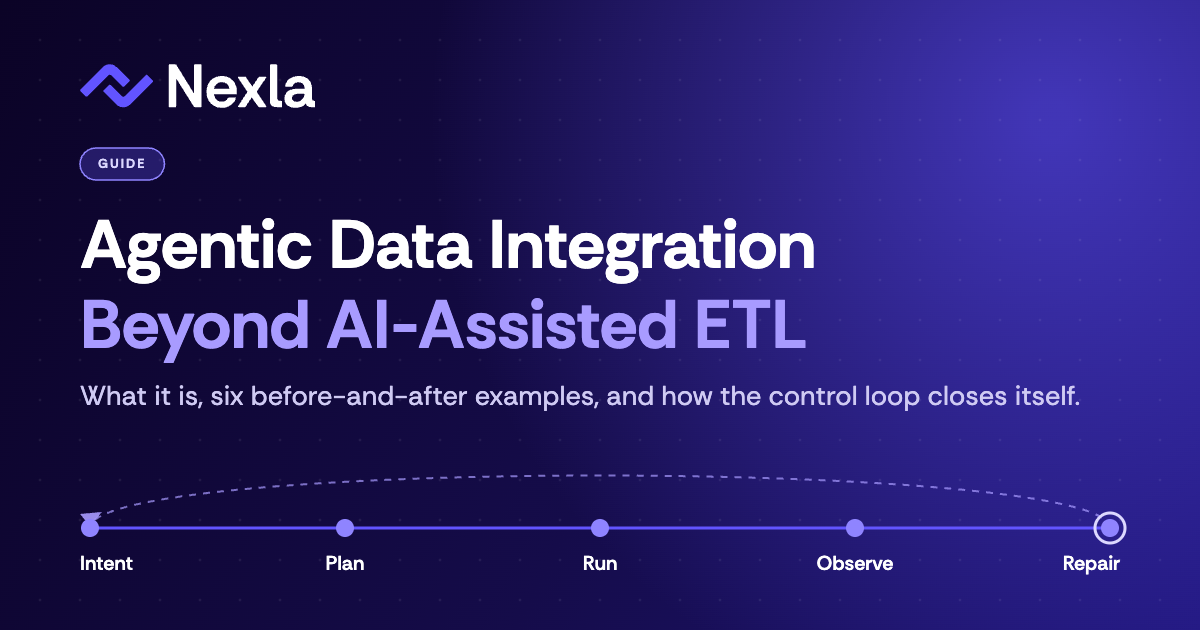
A useful way to understand agentic integration is as a control loop rather than a single prompt. The agent receives an objective and relevant constraints, chooses tools and integration patterns, observes the result, and uses runtime evidence to decide whether the pipeline is healthy or needs another action.
- Understand the intent and constraints
The agent starts with the desired outcome: for example, load Salesforce opportunities into a warehouse every hour, mask sensitive fields, and sync closed-won accounts to an operational application. It also needs constraints such as freshness, destinations, permissions, quality thresholds, and whether production changes require approval.
This is where context matters. An agent that knows only column names will misread a field like stage or amount. Nexla’s Helix Context Layer grounds the agent in business meaning, metadata, API specs, and prior execution logs before it plans anything. Read more on why this matters in Context Engineering for Enterprise AI.
- Plan and build the pipeline
The agent selects connectors, infers schemas, recommends mappings and transforms, chooses an ETL, ELT, streaming, or API pattern, and configures scheduling or event triggers.
Express illustrates this step. Its Data Flows mode turns a plain-English requirement into a governed pipeline and Nexset rather than returning code for a person to assemble. It draws on Nexla’s bidirectional connector library, so the same request works whether the source is a SaaS app, a database, a file drop, or a Kafka topic. For a walkthrough of building a multi-source feed this way, see Building a Production Agent Data Feed.
- Run, observe, and diagnose
Once deployed, the pipeline produces operational evidence: run status, freshness, schema changes, validation failures, API responses, and destination errors. Agentic data management becomes important here because the agent needs metadata, lineage, policies, and quality signals to distinguish a temporary retry from a structural problem.
Express includes a Triage mode for exactly this step. You point it at a failing flow and it returns a diagnosis and a proposed fix, using the run history and Nexset metadata Nexla already holds for that pipeline.
- Repair, adapt, or escalate
If a source adds a field, an API rate-limits requests, or a quality rule starts failing, the agent chooses an allowed response such as retrying, adjusting a mapping, quarantining bad records, or proposing a change for approval. Production autonomy should be bounded. Destructive changes, uncertain fixes, or policy-sensitive actions should escalate rather than execute silently. Six Agentic Data Integration Examples: Before and After
The clearest agentic data integration examples are not cases where AI writes pipeline code faster. They are workflows where the system uses feedback from the pipeline to decide and execute the next appropriate step.
Scenario
Before
With agentic integration
Where it runs on Nexla
Schema drift
Pipeline fails or an alert sends an engineer to update mappings.
Agent detects the new schema, evaluates downstream impact, updates an allowed mapping or proposes the change, then validates the resumed flow.
Nexsets carry schema and validation, so drift is detected at the data product, not per pipeline. Triage in Express proposes the fix.
New SaaS source Engineer configures a connector, inspects objects, maps fields, and builds the flow.
Agent interprets the requirement, selects the connector, discovers objects and schema, creates the data product, and deploys the approved flow.
Bad records reach quarantine and wait for investigation.
Agent correlates the failed rule with source changes, isolates affected records, applies an approved remediation or escalates with evidence.
Nexset validation rules and error handling, with Triage for diagnosis.
API failure or rate limit
Retries follow static settings or operations intervenes.
Agent interprets the response, adjusts retry timing within policy, preserves state, and resumes from the appropriate step.
Managed connectors handle pagination, auth refresh, and retry state so the agent reasons about policy, not plumbing.
Pipeline performance
Engineer reviews logs and metrics after an SLA breach.
Agent identifies the bottleneck, compares safe options, applies an approved optimization or recommends a change with expected impact.
Run metrics and lineage in the Nexla platform. See the pipeline risk agent example.
Destination or write-back change
A new operational sync requires another manually built pipeline.
Agent reuses the governed data product, adds the destination and write-back logic, validates permissions, and deploys after required approval.
The same Nexset feeds a new reverse ETL destination or an MCP server without rebuilding the source flow.
How Agentic Data Integration Differs From Traditional ETL
Traditional ETL is deterministic by design: engineers define sources, transformations, schedules, dependencies, and error handling in advance. That remains valuable for stable, well-understood workloads.
Agentic ETL changes the control plane around those deterministic operations. The agent translates intent into a plan, selects from available tools, interprets runtime evidence, and adapts the workflow without requiring a person to handle every exception by hand.
The difference is not that an agent replaces SQL, Spark, orchestration, or streaming engines. Those systems still execute data work. The agent operates above them, deciding how to configure and use those capabilities and when a changed condition requires another step.
This distinction is important for technical accuracy: autonomy in the control loop does not eliminate the need for deterministic execution, idempotency, checkpoints, lineage, testing, and access controls. Nexla’s architecture keeps those in the platform layer so the agent inherits them instead of reimplementing them per pipeline.
Where Event Streams and Near-Real-Time Integration Fit
Event streams make the value of an agentic control loop especially visible because the environment changes continuously. Kafka, Kinesis, Pub/Sub, CDC feeds, and similar sources deliver events as they occur, while downstream consumers require different transformations, freshness targets, and delivery guarantees.
Near-real-time data integration has two problems to solve: processing the events reliably and keeping the surrounding pipeline healthy as schemas, volumes, and destinations change.
The streaming engine remains responsible for processing semantics and fault tolerance. Spark Structured Streaming, for example, provides scalable, fault-tolerant stream processing. Nexla supports event stream processing and CDC alongside batch, ETL/ELT, APIs, and reverse ETL, including a native Confluent integration for Kafka. The agentic layer monitors freshness and schema drift, reasons over failures, modifies permitted configuration, and escalates conditions that fall outside policy.
Because Nexla packages incoming stream data into governed Nexsets, the same event stream feeds analytics or operational destinations while also becoming schema-rich data available to AI agents through MCP.
What Agentic Data Management Adds
Agentic data management is broader than pipeline construction. It applies agentic behavior to discovery, metadata interpretation, quality management, governance, lineage, and operational maintenance. These capabilities matter to integration because an agent cannot safely repair a pipeline if it does not understand the data product, its downstream dependencies, or the policies attached to it.
Nexsets provide a useful abstraction for this layer. They package schema, semantic types, samples, validation, error handling, audit information, and access control behind a reusable data product. Instead of reasoning directly over every source-specific representation, an agent works with a governed logical model that is reused across ETL, ELT, streaming, APIs, analytics, and AI workflows. Helix adds the business context on top: what the fields mean, how they relate, and how previous runs behaved. For how metadata turns raw feeds into these reusable products, see Metadata-Intelligent Integration.
How to Implement Agentic Data Integration Safely
Start with a bounded workflow rather than granting broad production autonomy. Choose a pipeline with clear inputs, outputs, quality checks, and failure modes, then define which actions the agent executes automatically and which require human approval. Schema additions, retries, and quarantining invalid records are usually low-risk. Deleting data, changing credentials, and altering sensitive access policies should require stronger controls.
Next, give the agent structured tools rather than unrestricted infrastructure access. Connectors, reusable transforms, governed data products, validation rules, lineage, and observability create a safer action space. This is the design principle behind MCP Studio: instead of handing an agent a database credential, you expose a task-specific set of governed tools over a Nexset, review each tool before it ships, and the agent works only inside that boundary. Nexla’s reasoning for task-specific servers over one-server-per-application is in The Future Is Not One MCP Server Per Application.
The system should preserve state, make actions idempotent where possible, log decisions, and support rollback or escalation. Durable workflow patterns are useful when agent actions span unreliable APIs or long-running processes because retries should resume safely rather than duplicate side effects.
Finally, measure the system by operational outcomes rather than how much code the model generates. Useful measures include time to deploy a new integration, mean time to diagnose and repair failures, percentage of changes handled within policy, freshness SLA attainment, data-quality incidents, and the number of escalations that required human judgment.
How Nexla Fits the Agentic Data Integration Model
Nexla brings the pieces of this model together without requiring the agent to replace the underlying integration engine. Each layer maps to a step in the loop.
Connectors provide bidirectional access to SaaS applications, databases, APIs, files, streams, warehouses, LLMs, and vector stores. Nexsets turn those sources into governed data products. The converged integration engine runs ETL, ELT, reverse ETL, CDC, streaming, and API delivery on the same foundation. Helix supplies the business context an agent needs to plan and diagnose correctly.
On top of that foundation, Express is the agentic interface. Data Flows builds and modifies pipelines from a prompt. Triage diagnoses failing flows and proposes fixes. MCP Studio turns any connection into a task-specific MCP server so downstream agents get governed tools instead of raw credentials.
The important architectural point is that the agent operates against managed connectors, metadata, validation, governance, and reusable data products rather than generating an isolated script and walking away. That makes agentic integration a lifecycle capability: design, execution, observation, adaptation, and governed action stay connected. For the broader picture of what a data platform needs to offer agents, see Data Platform for AI Agents: 7 Capabilities to Demand.
Conclusion: From Automated Pipelines to Adaptive Integration
Agentic data integration extends automation from individual pipeline steps to the integration lifecycle itself. Traditional ETL executes logic engineers define in advance. AI-assisted integration helps engineers create that logic faster. An agentic approach plans, runs, observes, diagnoses, and takes governed corrective action as conditions change.
The underlying data engines still matter, especially for deterministic transformations, streaming semantics, and reliable execution. What changes is the control loop around them.
For enterprises, the practical opportunity is not unrestricted autonomy. It is reducing the manual work between an integration requirement and a reliable outcome while preserving governance, lineage, quality, approvals, and observability. Nexla’s combination of connectors, Nexsets, converged integration patterns, Helix, and Express gives you a concrete model for applying that approach across batch, ETL/ELT, APIs, and near-real-time event streams.

Try it on a single flow at express.dev, or book a demo to walk through the control loop on your own sources.
The Context Layer for AI Agents: Definition, Five Capabilities, and How It Works
What a context layer for AI agents is, the five capabilities that separate one from relabeled ETL, how it works at runtime, and a test for each capability you can run against any vendor.
Tools to Build a Context Layer From Multiple Data Sources: A Buyer’s Framework
Connectors are necessary and insufficient. A provider-blind buyer’s framework for building a context layer from multiple data sources: five capabilities beyond ingestion, a scoring rubric, TCO per source, where CDC fits, and a reference architecture.