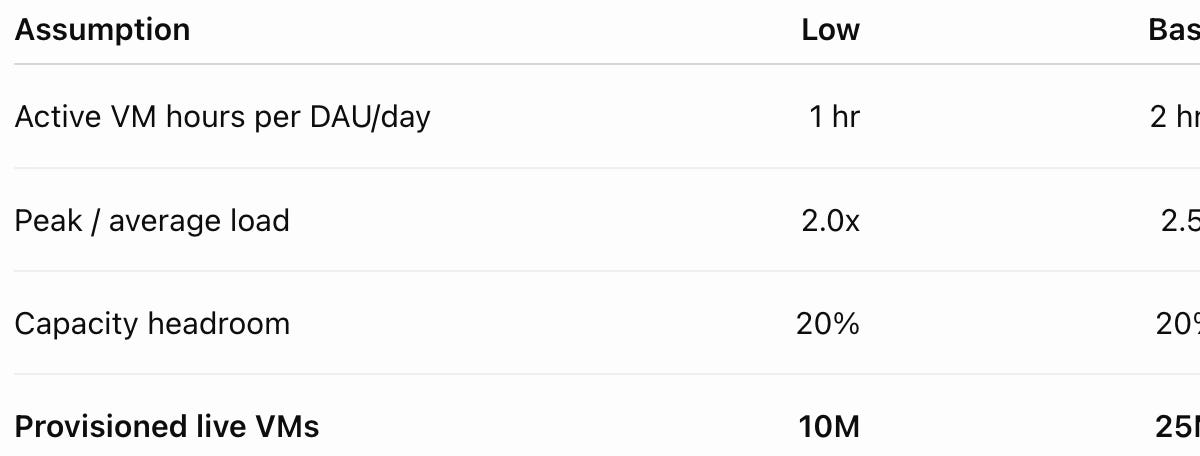
There are obviously a lot of moving assumptions: how long agents stay active, how aggressively CPUs and memory can be oversubscribed, how many model calls an agent generates, and how efficiently those models are served.
Rough conclusion is:
- ~1–2 GW of average total power to serve 100M DAU in the base case, of which only**~0.1 GW comes from the CPU/VM layer** . Depending on the # of reasoning-equivalent model calls one Muse DAU generates per day,3-4GW is entirely plausible.
- The sandbox layer = sub $1B****of CPU content and**~$2B of DRAM content, which is smaller than many expected.**
Welcome all feedbacks/ pushbacks.
Two very different pieces of infrastructure behind Muse.
- Muse VM / sandbox infrastructure
2 vCPUs, ~8 GB of RAM and ~100 GB of persistent logical storage per user. Observed Muse VM configuration 2. Muse Spark inference
Model inference goes out through Meta's external inference infrastructure. Meta’s description of Muse architecture
A. CPU #
The first mistake is assuming that 100M DAU means 100M VMs are actively consuming compute at the same time.
Suppose the average Muse DAU has an agent actively working for two hours per day.
100M users * 2 hours / 24 hours = ~8M average simultaneous active VMs
Meta obviously cannot provision only for the daily average. Usage will be concentrated during waking hours and bursty.
Assume a 2.5x peak-to-average ratio: 8M * 2.5 = ~20M peak active VMs
Then add roughly 20% capacity headroom: ~25M provisioned live VMs. So the base assumption is effectively that Meta needs enough infrastructure to support roughly 25% of DAU being live simultaneously.
The next important distinction is between virtual CPU allocation and physical CPU demand. Agent sandboxes are particularly well suited to CPU oversubscription. They spend a lot of time waiting. During those periods, the VM may still be alive, but it is barely using CPU.
DeepSeek’s recently published DSec infrastructure provides a useful benchmark. Its production agent sandbox platform runs approximately 30,000 physical CPU cores and 250TB of DRAM across ~160 nodes, with peak concurrency above 380,000 sandboxes. DeepSeek DSec paper. DSec also demonstrates stable operation at around: 800 microVMs per node. With roughly 188 physical cores per node: 188 physical cores / 800 microVMs = ~0.23 physical cores per live VM.
DeepSeek is obviously the King of efficiency. The number for Muse might be at 0.3-0.75 physical cores per live VM, or assume 0.5 physical cores per live VM as the base case. That is equivalent to roughly two simultaneously live Muse VMs per physical CPU core.
Using the base assumptions: 25M live VMs * 0.5 physical cores per VM = 12.5M physical CPU cores. On a 256-core CPU: 12.5M cores / 256 cores per CPU = ~50K CPUs; Or on a 192-core CPU that would be 65K CPUs.
At the current public pricing, that is ~$800M.
B. DRAM #
CPU can be aggressively oversubscribed because a VM that is waiting may consume almost no CPU. Memory is harder to oversubscribe because a live VM still needs to retain its working state.
Muse exposes roughly 8GB of RAM to the user environment, but one observed instance was actually using only around 3GB at the time of measurement.
25M live VMs * 3GB = 75PB of physical DRAM, call it ~75-100PB of physical DRAM feels like a reasonable base range.
At the current public pricing, that is ~$2B.
C. Sandbox power #
~0.1 GW for the entire Muse sandbox / VM layer at 100M DAU.
Muse’s personal computer executes tools and stores state locally, but the actual model runs on separate inference infrastructure. Meta’s Muse architecture
Energy per inference event #
Microsoft’s 2026 study estimates that optimized frontier-scale inference consumes a median of approximately: 0.31Wh per normal query
But a long reasoning query with roughly 15x the token count consumes approximately 13x as much energy, or around: 4Wh per long reasoning query
The study specifically highlights reasoning and agentic workloads as significantly more energy intensive. Microsoft Research on AI inference energy
For a Muse-like workload, let’s assume 5-10Wh per heavy reasoning-equivalent inference event as a rough sensitivity range.
Sensitivity analysis on # reasoning-equivalent events per DAU per day #
Assume 50 reasoning-equivalent events per DAU per day
Suppose each active Muse user generates the equivalent of 50 heavy inference events per day.
At 5Wh each:
100M users * 50 events/day * 5Wh = 25GWh/day
25GWh/day / 24 hours = ~1.0GW average power
So inference alone could require: ~1-2GW of average power
So a 3-4GW Muse is entirely plausible. Maybe that’s why Meta is rumored to be adding 7-10GW of compute next year.
The popular framing around Muse is that giving every user 2 vCPUs and 8GB of RAM creates an enormous CPU requirement. But the naive calculation materially exaggerates the CPU requirement because it treats logical VM allocation as dedicated physical infrastructure.
The more interesting conclusion is: Consumer agents may be a meaningful new demand driver for CPUs and conventional DRAM, but inference remains the real compute bottleneck. And as agents do more work, run longer trajectories and increasingly spawn other agents, inference demand can scale much faster than the number of users itself.