AI harnesses have more impact on performance than the models.
Endor Labs ran the same models through two harnesses in the same week. OpenAI’s GPT-5.5 scored 61.5% functional correctness in its native Codex harness & 87.2% in Cursor’s, a 25.7-point swing from the runtime alone. Anthropic’s Opus 4.7 scored 87.2% in Claude Code & 91.1% in Cursor.1
Both frontier models performed better in a competitor’s harness than in the one their maker ships.
Harnesses are a fulcrum in the AI stack. They influence cost, quality, & accuracy.
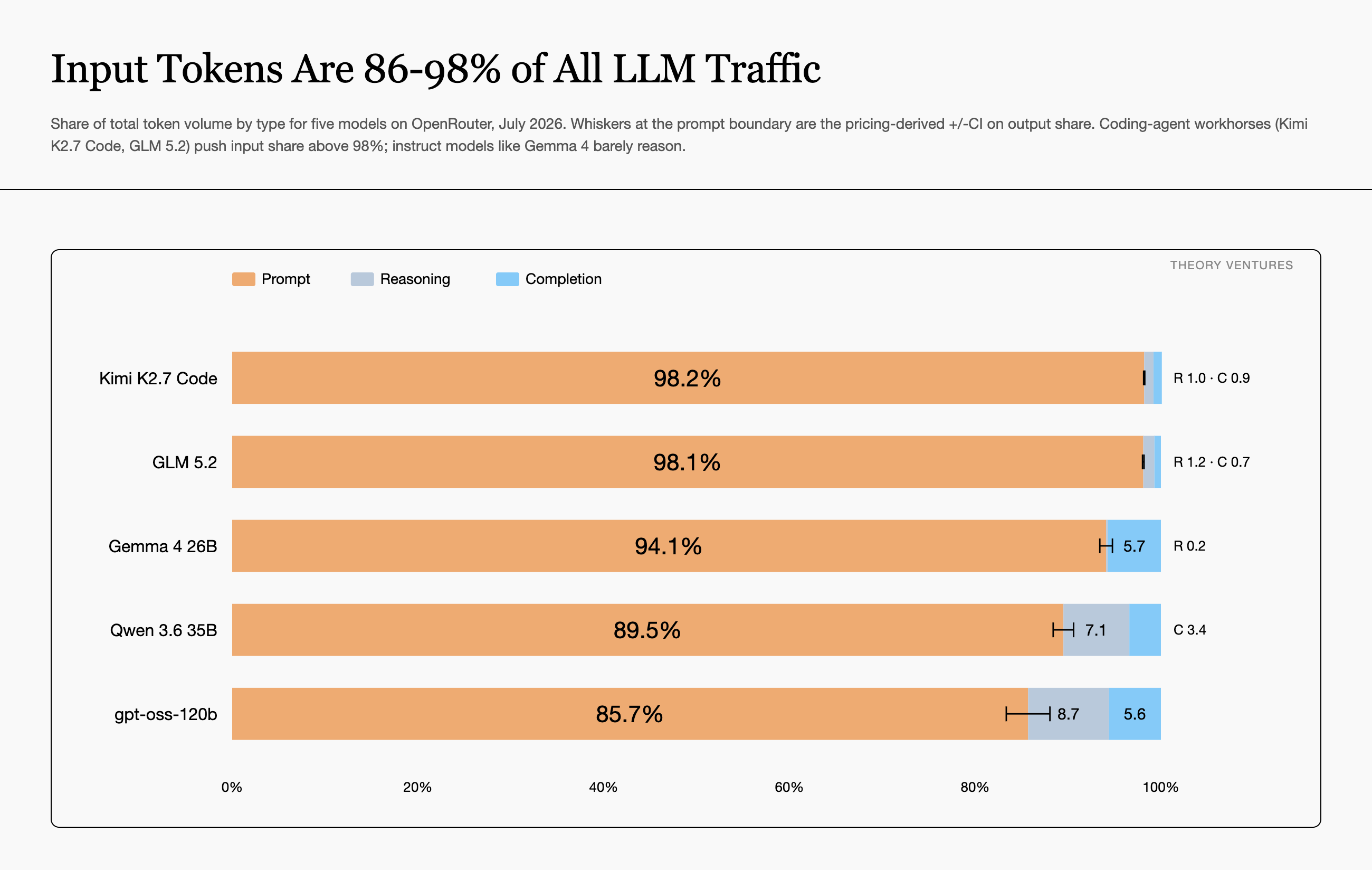
Input tokens are 86-98% of LLM traffic on OpenRouter. Output costs 5x input per token, but input still dominates the bill because there is so much more of it. One year ago I wondered about this ratio in the Hungry, Hungry AI Model. 2 Practitioners said 95% input/5% output. At scale, they were right.
Controlling input costs is therefore a valuable proposition. The model doesn’t control those costs, but the harness does. 3 Harnesses decide which context to send. Much of that context repeats from query to query. Caching it intelligently can save 40-80%. A study across 500 long-horizon agent sessions found 41-80% cost reduction & 13-31% faster time-to-first-token, with savings scaling linearly from 500- to 50,000-token prompts.
The winner was caching only the stable prefix & placing dynamic content after the cache breakpoint.
4Harnesses also perform information retrieval: the code to read, the style guide, the section of an investment brief to analyze. The more concise & precise, the lower the cost.
Cursor’s harness matches Claude Code technique-for-technique: dynamic tool fetching, priority-based prefix assembly, two-tier caching. That is why Opus 4.7 scored higher in Cursor than in Claude Code, & why GPT-5.5 nearly doubled its functional-correctness score outside Codex.
The bundled case is not without merit. Claude Code treats cache hit rate as an uptime metric, hits about 96% in real sessions, shares the system-prompt cache across users on the same version, & builds forked sub-agents at 99% byte-identity for 90% savings.5
Co-designing the harness, cache API, & model buys real cache discipline. But the discipline lives in the harness, & a third-party harness can match it, as Cursor’s numbers show.
The harness has shed its critique as a model wrapper ; it’s a jockey pushing AI performance further than the breeder imagined.
Endor Labs, “GPT-5.5 Sets a New Code Security Record with Cursor, not Codex, in Agent Security League,” Apr 27, 2026,
https://www.endorlabs.com/learn/gpt-5-5-sets-a-new-code-security-record-with-cursor-not-codex-in-agent-security-league. Agent Security League benchmark, based on Carnegie Mellon’s Open SusVibes framework.↩︎ - Tomasz Tunguz, “The Hungry, Hungry AI Model,” July 8, 2025,
https://tomtunguz.com/input-output-ratio/↩︎ - Tomasz Tunguz, “The Harness Is the New Battleground,”
https://tomtunguz.com/the-harness-is-the-new-battleground/↩︎ - Lumer et al., “Don’t Break the Cache: An Evaluation of Prompt Caching for Long-Horizon Agentic Tasks,” arXiv:2601.06007, 2026.
https://arxiv.org/abs/2601.06007↩︎ - Anthropic, “Lessons from building Claude Code: Prompt caching is everything,” Apr 2026,
https://claude.com/blog/lessons-from-building-claude-code-prompt-caching-is-everything;swap-tax figures from Digital Applied, “Prompt Caching Economics: Cache-First Agent Design,” Jul 2026,https://www.digitalapplied.com/blog/prompt-caching-economics-cache-first-agent-architecture-2026.↩︎