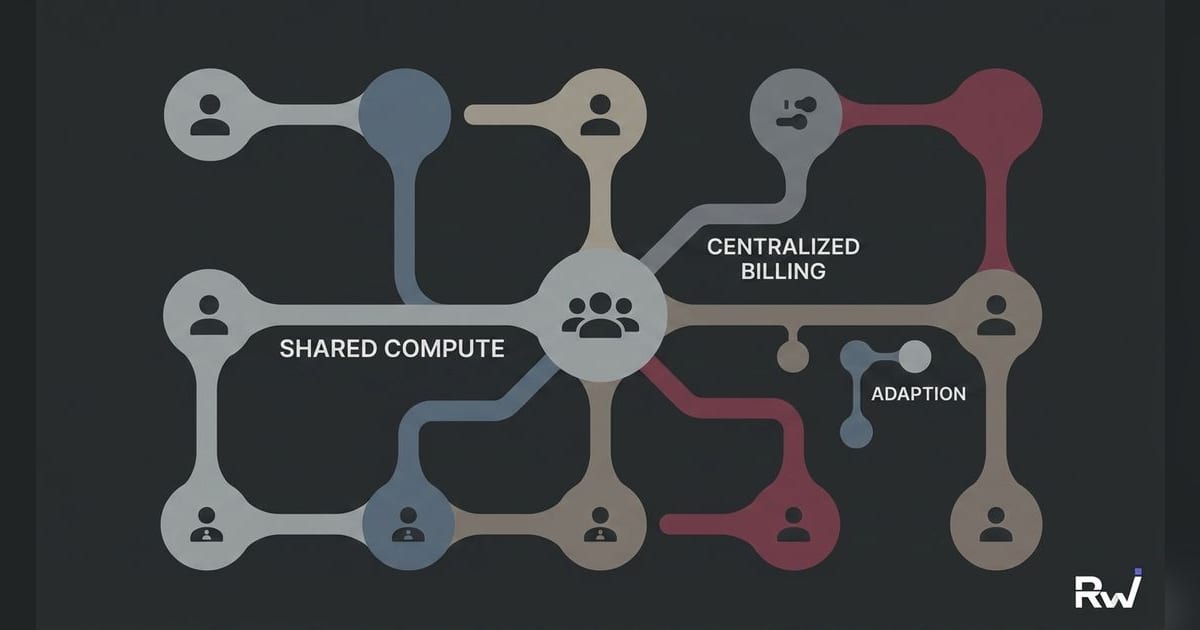
Sara Hooker (@sarahookr) and Sudip Roy (@sudip_r0y) launched Adaption Teams on July 21st, adding shared compute, centralized billing and member-level controls to the AI lab's model-building platform.
https://x.com/adaption_ai/status/2079536869340221653 Adaption described the release in a two-post thread on X as a workspace where multiple users can build, evaluate and adapt models together. One account owner handles billing, while administrators can control access for each member. Adaption did not disclose pricing, seat limits or the specific permissions available at launch.
The release turns collaboration and spending controls into product features around workflows that Adaption previously sold primarily as tools for individual builders and early-stage teams. That account layer matters because training and evaluation jobs consume shared compute, generate artifacts that several employees may need to inspect and create costs that finance or engineering leaders usually want assigned to one organizational owner.
From research tools to team infrastructure
Adaption's developer documentation describes two principal systems available through its web application and API. Adaptive Data ingests, modifies, evaluates and exports training datasets. AutoScientist automates parts of model training by adjusting data and training recipes against a stated objective.
The July 21st announcement suggests Adaption is packaging those systems for groups that divide model development across machine learning engineers, data specialists, evaluators and budget owners. Shared compute removes the need for each user to maintain a separate pool, while consolidated billing gives Adaption a cleaner path into organizations that require centralized procurement.
Adaption has been building toward that organizational sale throughout 2026. The lab opened early access to Adaptive Data in February, followed by a Python SDK and API in April. It released AutoScientist in May and expanded the model-training system to work across text and images on July 16th.
The documented workflow now spans file ingestion, data adaptation, evaluation and export. Users can import datasets from local files, Hugging Face or Kaggle, estimate the compute credits a job will consume, and run the same lifecycle from the web app or code. Teams adds the administrative layer around that technical workflow.
Hooker and Roy are commercializing an efficiency thesis
Hooker and Roy founded Adaption after working at Google and Cohere. Hooker led research at Google Brain and Cohere, while Roy worked on Google's Pathways infrastructure and later led inference and platform engineering at Cohere, according to Emergence Capital's account of its investment.
Their central bet is that useful AI systems will need to change after deployment instead of depending on repeated calls to large, fixed models. Hooker argued in June that static models force customers to keep paying for the same mistakes through compute, API calls and infrastructure. Adaption's products address that cost argument at the data and training layers; Teams applies it to how organizations allocate and oversee compute.
Adaption raised a $50 million seed round on February 4th, led by Emergence Capital with participation from Mozilla Ventures, Fifty Years, Threshold Ventures, Alpha Intelligence Capital, E14 Fund and Neo. The size of that round gave Hooker and Roy room to build research systems before proving a conventional software sales motion.
Teams is part of that sales motion. Model-training platforms compete on technical performance, yet organizational adoption also depends on routine controls: who can start a run, whose credits are consumed and who receives the invoice. Adaption has supplied the first outline of that account structure without publishing enough detail to compare its permissions or economics with other managed AI development platforms.
The launch also narrows the distance between Adaption's research agenda and a product an engineering organization can administer. Hooker and Roy began with a thesis about continually adapting intelligence. Their immediate commercial task is making the underlying experiments governable, repeatable and payable by a team rather than a collection of separate users.