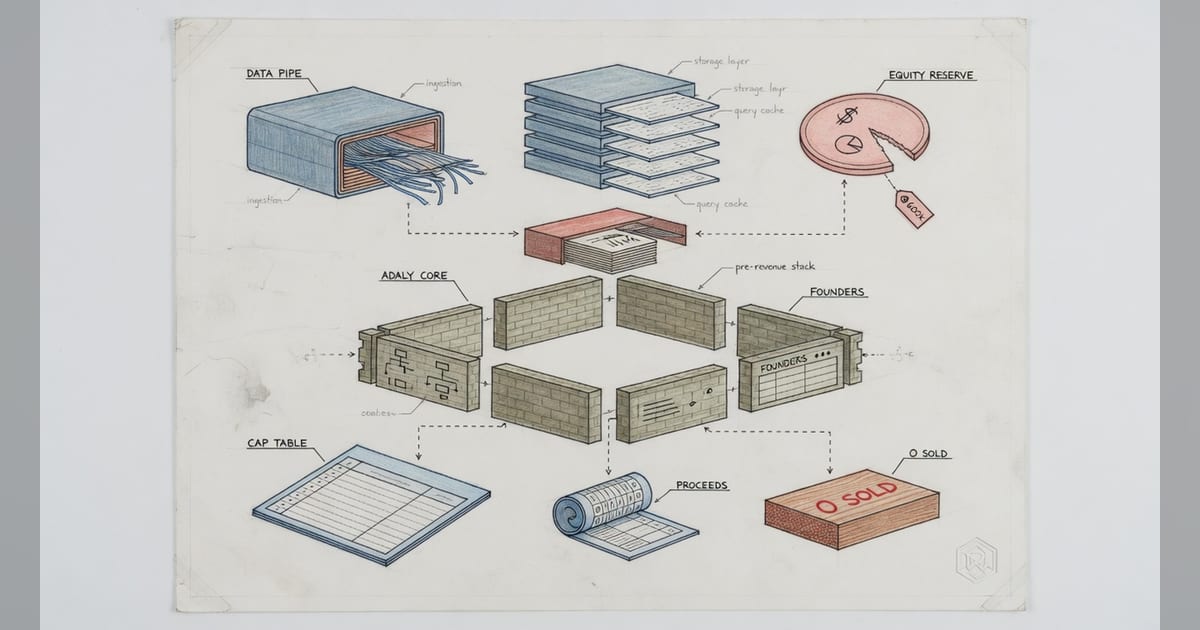
Enterprise data startup Adaly filed a Form D notice for an $11 million offering on August 13, 2026. Kyle Csik, Adaly's CEO, and Aleksandar "Sasha" Grujicic, its CTO, are seeking capital as they build software designed to connect AI agents with operational business systems.
The filing does not establish how much Adaly has sold. Participating investors, the company's valuation and its total funding to date also remain unverified.
Form D is a notice of an exempt securities offering. Filing one does not establish that an offering has been fully sold or that a financing has closed.
A financing notice follows Adaly's product launch
The filing came less than three months after Adaly announced the commercial launch of its federated DataOS. In its May 27 launch announcement, the company said it was working with Fortune 500 businesses across healthcare, media, retail and consumer packaged goods. Adaly has not named those organizations or disclosed revenue, pricing, deployment scale or technical performance.
In a May 16 company post titled "Thank You To Our Pilots", Adaly said its pilots included a Fortune 500 food company, several large retailers, two media agencies and a major publisher. The post did not identify those organizations or establish how many became paying customers. Adaly's LinkedIn company page listed approximately 15 employees, while other public listings place it in the broader 11-50 employee range.
Adaly's software queries data in the systems where it resides. The company says its DataOS can connect models, applications, AI agents and employees to operational records without requiring customers to copy everything into a warehouse or data lake first. Adaly also says the system preserves permissions, lineage, auditability and governance from the underlying systems and does not train on customers' underlying data. Those security and deployment claims have not been independently validated.
The company launched three packages. Vessel is an embedded connectivity layer for applications, models, agents and workflows. Adaly's launch announcement describes Studio as a hosted platform where technical and non-technical teams orchestrate systems from an analytical workspace. Atlas is a bespoke deployment for complex institutions. Adaly says the platform can support read and write access, allowing an agent to act inside an operational system after retrieving information.
Write access increases the engineering and governance burden. An agent that changes inventory, customer, financial or clinical records needs tightly enforced permissions and a reliable audit trail. Adaly's LinkedIn description says its federated architecture respects existing permissions and security models. The company has not published independent benchmarks or production-reliability data.
Adaly enters a crowded enterprise data market
Adaly's product overlaps with established data-virtualization and query platforms, including Denodo, TIBCO Data Virtualization, Starburst and Dremio. Denodo describes its platform as a way to provide access across source systems without replicating the underlying data, while TIBCO, Starburst and Dremio are commonly positioned around virtualized queries or lakehouse infrastructure.
The adjacent agentic-data category includes Reltio AgentFlow, which centers on master data and customer context; Acceldata's agentic data-management platform, which emphasizes data management and observability; and Dataiku's agent platform, which extends a data-science and governance product into agent workflows. VAST Data markets an AI data platform spanning structured and unstructured information.
Adaly positions its distinction as combining live federation with semantic context, existing governance and the ability for agents to write back to source systems. That is product positioning rather than evidence of superior performance. The company has not disclosed comparative latency, connector coverage, implementation time or customer retention.
The timing reflects a practical constraint facing enterprise AI deployments: agents need current information and, when permitted to take actions, controlled access to operational systems. Adaly must show that its agent and write-back capabilities can operate within corporate security controls at production scale.
Csik and Grujicic are selling an infrastructure thesis
The Org lists Csik as an Adaly co-founder since May 2024 and a former chief data and technology officer at Night Market. It also says he studied chemical physics and mathematics at Rutgers University and previously worked at Media.Monks/Data.Monks. A company-linked industry profile describes Grujicic as having more than 20 years of experience leading technology adoption and AI initiatives for Fortune 500 companies.
Adaly's public materials describe the company as New York-based, while its SEC filing uses a Wilmington, Delaware address. The available records do not establish where most of its employees work.
Csik and Grujicic argue that enterprise AI projects stall because operational data is fragmented across systems and warehouse copies can become stale or lose permissions attached to the original records. On Adaly's company page, they frame federation as a way to give software and employees governed access to current information without first centralizing every record.
In a May founders' letter, Csik and Grujicic wrote that they had prioritized connectors and governance work over features designed to make demonstrations appear complete. That approach carries a demanding financing profile: enterprise infrastructure vendors must build integrations, pass security reviews and support long sales cycles before deployments expand across a large organization.
The Form D puts Adaly's $11 million financing effort on the public record without identifying investors or establishing its valuation. Adaly says in its launch announcement that it is working with large companies, but it has not disclosed the commercial scope, revenue or production usage behind those relationships.