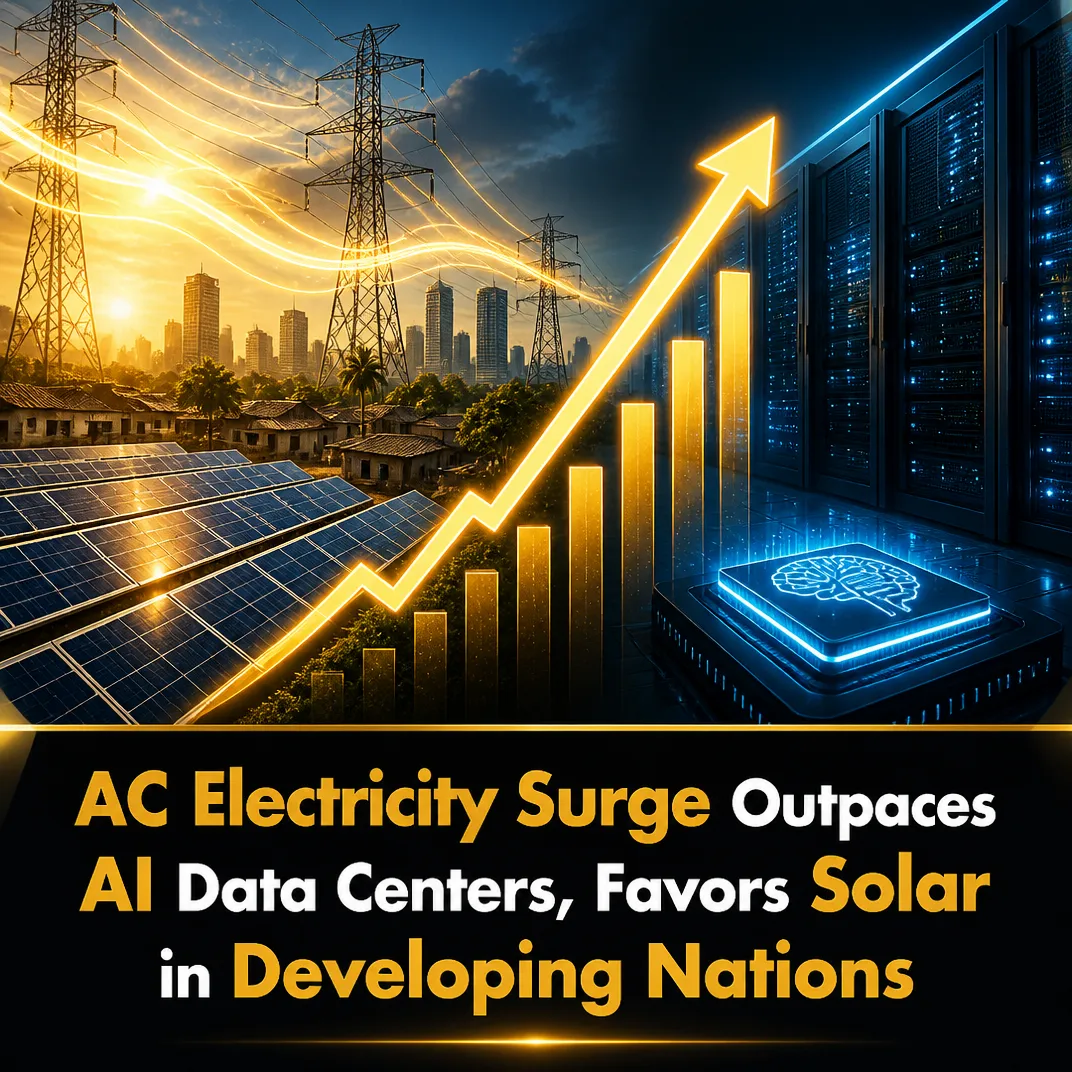
July 21, 2026, (Inside AI) — Air conditioning is set to drive far more electricity demand than artificial intelligence over the next decade, yet its power needs align better with cheap solar energy and carry fewer social costs, according to a new Reuters Breakingviews analysis.
Global electricity use for cooling has expanded by 4% annually since 2000, reaching about 2,900 terawatt-hours last year, or roughly 10% of world consumption, the International Energy Agency reports. If that pace continues, cooling will add some 1,400 terawatt-hours by 2035 — nearly double the 700 terawatt-hours the IEA projects for data centers in the same period.
This surge is fueled by two unstoppable forces: rising global temperatures and growing wealth in developing nations. June 2026 was the second warmest on record, and scientists expect the full year to be the hottest ever due to a rare Super El Niño. In India, per capita income has nearly quadrupled in two decades, driving AC adoption even as temperatures hit 48 degrees Celsius in Uttar Pradesh, a state with nearly 250 million people.
"While India is hot and getting hotter its per capita income is shooting up, nearly quadrupling over two decades. Hence a lot more people are installing air conditioning," the analysis notes. The IEA says only about a fifth of European homes had AC in 2022, while India's penetration is perhaps half that — leaving decades of growth ahead.
Yet unlike AI's round-the-clock data center loads, cooling demand peaks during sunny hours, making it a natural match for solar power. NextEra Energy estimates solar firmed with batteries will cost $35 to $75 per megawatt-hour by 2030, compared to $90 to $111 for a new gas plant. Solar already met three-quarters of new electricity demand last year, per think tank Ember.
"Air conditioning use mostly synchronizes with sunshine, with a few extra hours after the sun sets. That makes it a natural match for solar, the cheapest and most rapidly constructed source of generation," the report states. This is critical for developing countries that lack financial heft.
By contrast, AI's data centers need 24/7 power, pushing tech giants toward gas turbines and even nuclear. Lazard estimates new nuclear's all-in cost is about twice that of solar-plus-batteries. Meanwhile, green power grows cheaper as conventional generation costs rise.
The social calculus also favors AC. The World Health Organization estimated in June that over 200,000 people in Europe died from heat in the past four years, with nearly all cases preventable, and 500,000 annual deaths globally between 2000 and 2019. AI power demand, meanwhile, has stoked electricity price hikes, pollution fears, and job loss anxiety in developed nations.
Efficiency gains are possible too. About half of new U.S. units are air-source heat pumps that also provide winter warmth, often cutting net energy use since heating typically guzzles more power.
The financial picture diverges sharply. Mature AC technology spreads gains widely: Lennox International trades at 20 times forward earnings, while peer Trane Technologies, with a data center cooling business, commands a 50% premium. In power generation, GE Vernova, a gas turbine giant, fetches over 50 times estimated EBITDA; Chinese solar leader JinkoSolar sits at just 6 times.
"Perhaps the financial play is to simply make broader bets," the analysis concludes. "It's safer to bet that cooling helps developing nations get richer than to assume the data center boom continues."