our full conversation on data centers, Alex Bores, x-risk, and jobs
Earlier this week, left-wing insurgent Abdul El-Sayed won the Democratic Senate Primary in Michigan. He beat Haley Stevens, a four-term moderate Democratic Congresswoman who represented one of AIPAC’s biggest campaign spends, and who was endorsed by governor Gretchen Whitmer and Chuck Schumer.
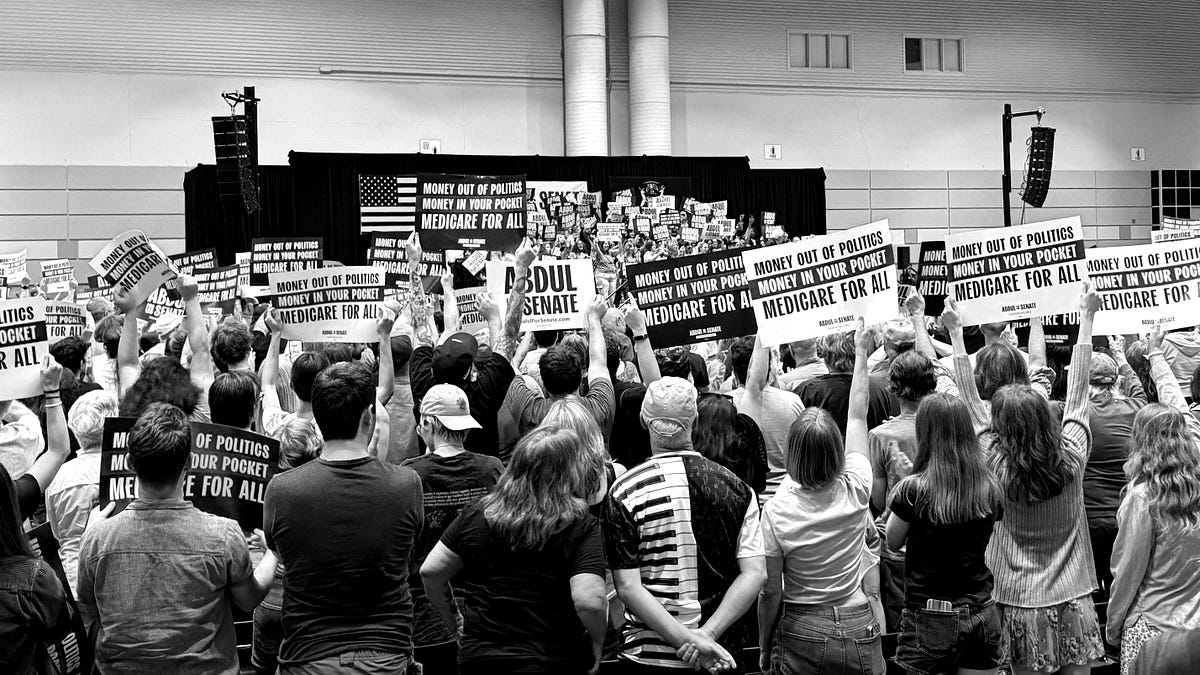
Abdul’s victory is a blow to the Democratic establishment in a crucial swing state—and a lesson in the kinds of fearless, populist, “fighter” candidates that today’s voters increasingly want to support. His Lansing rally with Bernie and AOC, more than anything else, crystallized the connection between data center opposition and voters’ anger about money in politics.
I spent 30 minutes chatting AI with Abdul while doing my data center reporting. He was surprisingly “with it” for a politician—citing everything from Moore’s Law to Mythos—and has a laundry list of aggressive AI policy ideas. Now that he’s won, and has a serious shot at the Senate, I wanted to share the full interview.
*ICYMI: Here’s my full story on data center fights in Wisconsin and Michigan. I also joined The Ezra Klein Show for a conversation on data centers, AI populism, the permanent underclass, and how the AI industry deals with it all. *
ANN ARBOR — July 20, 2026 This interview has been very lightly edited for clarity. It is not an endorsement.
Jasmine Sun 03:39
You must be having a crazy time.
Abdul El-Sayed 03:42 It’s an interesting moment of life. These are those moments where weeks happen in minutes. When you’re not overcome by existential anxiety, there’s a real thrill to living in this space.
Jasmine Sun 04:03
To give you a bit of context, I’m a journalist working on this long-form project on the politics of the AI buildout. I met the Saline organizers this morning, and have been talking to folks in Port Washington, Janesville, Mount Pleasant. We talked to city officials and labor leaders; we met the Hong campaign. I’m normally in San Francisco, which is a very different sort of bubble and perspective on AI.
Abdul El-Sayed 04:54 It’s always wild. The times that I’ve been in San Francisco, you look at the billboards and, I don’t know. Who is this meant for? Then you realize what it’s meant for — and this is the inflation of the amount of money you’re talking about — the whole point is for a very small number of people to talk to another very small number of people to manage huge amounts of money flow. And it just reminds you how warped the economics is.
Jasmine Sun 05:21
Yes, it’s a totally different world. I’d be really curious to start with what your story is for why people are so concerned about the data center buildout. Is it about AI? Is it about the environment? Is it about something else?
Abdul El-Sayed 06:28 Most of the time, when people think about the use of space, it’s for a trade-off. We’re going to build a school. Okay, well, it might be inconvenient to have that school right close to my house, but it’d be great if our kids got good educations, and schools come with playgrounds, and maybe it wouldn’t be that bad to have a school next door.
In this case, it’s: we’re going to build a data center. And they’re like, oh, so what’s it going to be? It’s just going to be this drone of a building that makes an odd sound all the time and sucks up all the electricity and could poison my water. Okay, what’s the trade-off? The buildout of an industry that everyone’s telling me — including the CEOs — is going to come for my job. So what is the upside? And you’re like, well, you can ask meaningless questions and queries to your ChatGPT. And people are like: I don’t want that, and it’s not worth it.
So ultimately, I think in the end, if you just ask people — who could care less about your billion dollars — why they should put this in their backyard, they’re going to say: I don’t want it in my backyard. I actually don’t want it in anybody’s backyard. I actually don’t want it. And that’s the revealed cost of the $20 ChatGPT or Claude subscription that they’re trying to give you.
And it’s wild, because most of the time the biggest proponents of technology tend to be the folks who are youngest. It’s funny, because the main users of chat and AI generally tend to be younger, and they hate it — but they use it, but they hate it. So it’s the perfect example of being like: I guess I have to do this because I’ve got to keep up with the Joneses, but I really wish the Joneses didn’t have this.
This entire industry feels misplaced, and it’s being driven by the interaction between all the worst players. Number one, tech billionaires who are already billionaires, who don’t really need more money but want power. And then VC firms who want to make more money. And then big corporations who want to automate your job. So who wins here? Definitely not the people who live there. And you’ll hear from folks who build the data centers, but even then, they’re dubious about the long range. They’re like:* this is a good three-month job, but then what? Am I going to have to pay for this in my electrical bill every month? Is it going to corrupt my water?*
Jasmine Sun 09:13
I’m interested in that tension, because I reached out to a few folks in the building trades and the unions, and they are good jobs, right? They’re getting paid very, very well.
Abdul El-Sayed 09:24 Building trades are used to doing episodic work. That’s the nature of their work. You’re moving from job to job to job, because things get built and then they’re built, right? You don’t need perpetual building most of the time. But this one gives them a lot of concern. When you talk to folks like business managers off the record, they’ll tell you: it’s a great job, and I’m not going to say no — I think it’s important that we fight for these jobs, and these are jobs that we have now. But when I go home, I’m kind of dubious of it all.
Jasmine Sun 09:53
Really? Okay. Because as a journalist, people are usually like: we want the data centers, we want the jobs. They are very well paying. We’re seeing a boom in apprenticeships, whatever. And I was going to ask you if there was a tension you had in managing your coalition, because most other people we talked to are pretty anti data centers.
Abdul El-Sayed 10:11 It’s important to me to take the voices of working people very seriously. I think when we fail to do that, we miss the bigger picture. And at the same time, the way that I’ve approached it is, I’ve tried to name the risks honestly. I don’t take money from the players, whether it’s Big Tech or the utilities, and I try to name the risks seriously and talk about what policy solution we really want here.
I’m sympathetic to the idea of a moratorium at the local and state level. I think the federal level is where we need action, because what’s happened right now is the data centers are able to pit local communities against each other for the least-common-denominator terms. And it tends to be that when you have a trillion dollars that wants something, a trillion dollars usually gets what a trillion dollars wants. My job is to manage that, to protect people from it. But if you ask me — data centers in the dirtiest form versus no data centers — I say no data centers.
So I think if you’re the industry right now, you want federal-level legislation that sets the terms. Because guess what? At the end of the day, the things that we’re asking for are not that expensive. You could do it if you wanted to. You have the money. I mean, this is all funny money anyway, right? All these valuations are bullshit. We all know that, and they all know that.
And then the other big question is, if you take seriously the argument that the tech community is making on its own terms: they’re saying there’s going to be a chase for AI that is going to build the AGI to end all AI. So there’s going to be one winner. And then you take Moore’s law into account, which says that compute gets exponentially more efficient. So you’re building all of this space, which we know is duplicative, and we know that there’s going to be one winner.
So what happens to all this excess data center infrastructure that you just built? We’re going to have these dead data centers that are just crashed-out infrastructure that gets scrapped for parts in a bunch of random rural communities. Nobody’s given me any assurances that that’s not going to happen.
So I don’t know, man. The whole thing is just whacked out. It’s the end game of the worst excesses of tech generally: to sell us shit we don’t need, but that a few very, very powerful people have decided can make money. You know what I mean?
Jasmine Sun 12:42
When I talk to industry folks, what they’ll say is: but don’t these communities really want the money? This is the biggest investment they’ve ever had. Isn’t that money going to go to schools? It’s going to go to roads. They don’t have to raise taxes on their residents.
Abdul El-Sayed 13:00 And what happens when Dario Amodei’s prediction that 50% of the white collar jobs are gone because of AI comes true? Great — you’ve got an amazing school to teach people skills that they can’t actually use on the labor market. Part of me is just like: listen to what you’re saying. It’s always funny to me. For a bunch of clearly very smart people—
Jasmine Sun 13:23
Smart about some things.
Abdul El-Sayed 13:24 — you are intelligent but dumb. You know what I mean? Hyper-intelligent, but just listen to what you’re saying: guys, we’re going to sell you this solution that’s going to take half your jobs. People are like: I don’t want that. Why do I want that? And you’re going to put it in my backyard.
I just think it’s important for us as a society to get this right, which is why I’ve tried to be very aggressive about what I think needs to be done, and to throw the gauntlet down and say there needs to be an honest conversation, come what may.
And frankly, maybe I’m in a position to do it because I already have $50 million of spending against me. What’s another $100 million super PAC at the end of the day? The law of diminishing returns only applies at this level. So I’m weirdly free to say everything that nobody else can say, because the only circumstance in which $10 million more doesn’t matter is when you have $50 million spent against you. So I’m like: yeah, $10 million more — what are you going to buy, a third ad in the commercial break?
Jasmine Sun 14:18
I was thinking about this during your rally, and during the Alex Bores race in New York: the more money the AI industry spends against you, the better it is.
Abdul El-Sayed 14:31 That is true, if you’re a campaign that can communicate through it. The hard part about congressional campaigns is that you don’t occupy the valence to command your own attention economy. You have to be big enough to communicate through it. That’s why $10 million of spending in a congressional race goes way further than $50 million in a Senate race. You know what I mean? And that’s the thing. You get an Alex Bores, who I don’t agree with on many things —
Jasmine Sun 15:04
He’s a lot more moderate.
Abdul El-Sayed 15:05 — yeah, but the one place I agreed with him was on AI. He’s just not able to communicate through that much spending against him. Whereas in my case, we knew what was coming, so we built a guerrilla-style campaign. When the British Army marches in, you do what they did to the British Army, which is shoot them in the back of the head. So we’re in a position now where we can command the ability to speak to our audience independent of the amount of money they’re spending to try to lie to the public.
But this is how these folks win. They’re able to move in congressional races in a pretty stealthy way, whereas in these big races, it’s a lot harder to do. And I also think in a presidential, they’re going to spend a tremendous amount of money and not be able to control the narrative, because by its nature the presidential election commands enough earned media on its own terms.
Jasmine Sun 15:59
Do you have an analogue that you think of when you think about how you want to regulate the AI industry? Do you think of pharma? Do you think of the banks? Or do you think AI is different?
Abdul El-Sayed 16:10 It’s some combination between the Fed, the FDA, and a public utility.