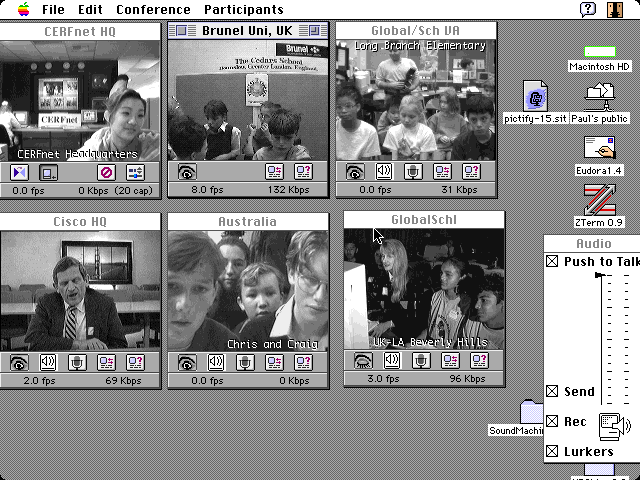
A story about Amara's law and why this is important with AI rn. The first time I saw video transmitted over the internet was in 1994 with a tech called CU-SeeMe in a program called Global Schoolhouse. It was tiny 320x240 grey scale image at about 4fps. Audio was over a land line. Students at multiple locations could see each other and talk, and little else. The next time was that same camera pointed at the stadium for the Lilyhammer Olympics. It did not replace NBC :-) I saw the closing ceremony as a stamp-sized still image of stadium lights, and little else. Those were enough for many people to be convinced that internet video was the best big thing. CU-SeeMe became one of the earliest pure play internet video companies (and one of the rare users of UDP!) It was also enough to convince the cable companies that internet video would never happen. I demonstrated this technology to countless CEOs and luminaries from my office at Microsoft. There was a near perfect correlation between age or corporate seniority and doubt vs. enthusiasm, consistent with everything internet and most tech back then. Today everyone uses internet video with resolution often higher than the tv they routinely use at home. And those cable companies that doubted internet connectivity and video distribute 4K tv over tcp/ip. These things roughly followed Amara's law saying that people [enthusiastic supporters] often over estimate progress/impact in the short term and other people [incumbents] often under estimate progress/impact in the long term. When people say AI is not ready or even more strongly AI will never do a certain, just keep in mind Amara's law and internet video. That is happening right now.
Embedding a font in a PPTX: the file that LibreOffice used, and the two it silently ignored