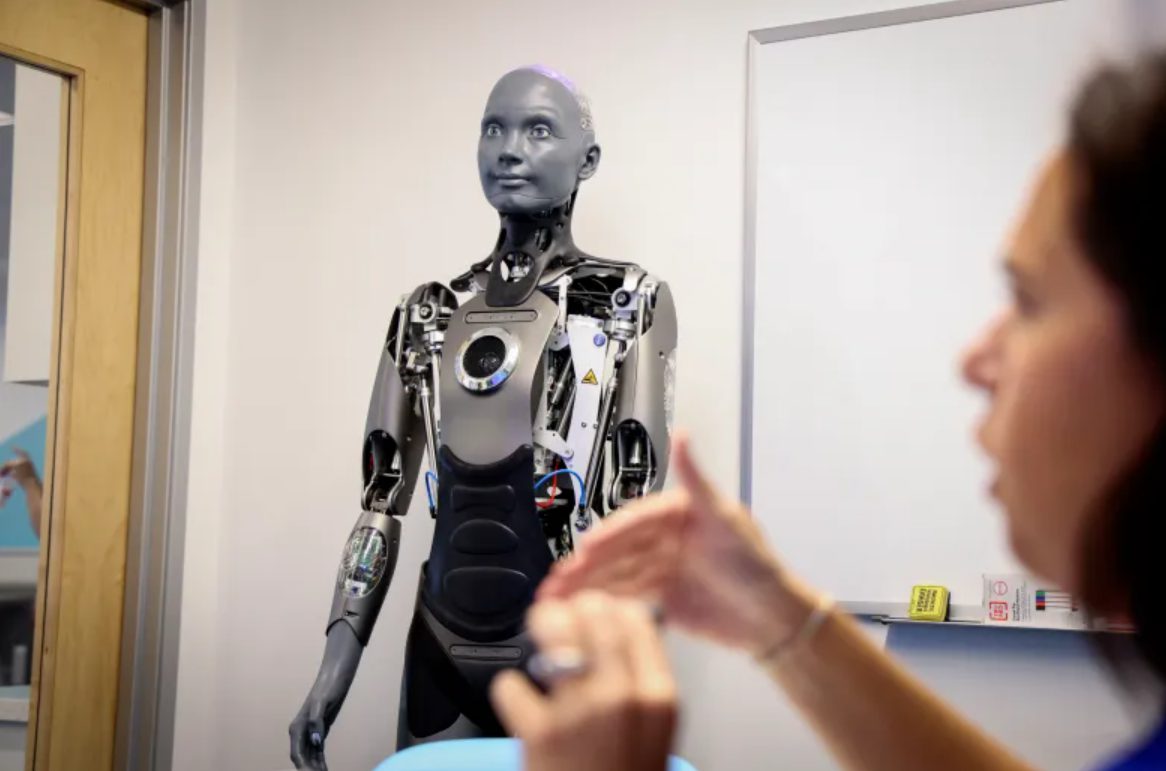
Imagine a resource center built for struggling teens — kids recovering credits, some experiencing homelessness, others managing disabilities. Now place a six-foot humanoid robot with a silicone face and camera-equipped eyes in that room. That’s exactly what Altus Schools, a San Diego charter chain serving grades 6–12, has done. The network purchased two Ameca humanoid robots from UK manufacturer Engineered Arts for a combined
$500,000## What Ameca Actually Is
Ameca is a highly expressive, stationary humanoid platform — sophisticated in conversation, rooted firmly to the floor.
Ameca stands nearly six feet two inches tall, weighs 137 pounds, and features 61 actuated movements plus dual 8-megapixel cameras embedded in its eyes. The silicone face produces eerily realistic expressions — think
Westworldproduction design on a museum-exhibit budget. One thing it won’t do, however, is follow your students around: Ameca doesn’t walk. It’s a stationary platform engineered for conversation, not locomotion. Full configurations run
$250,000 to $500,000 per unit, according to robotics resellers.
Altus programmed each robot with four distinct personas:
Sage— explains academic concepts and answers content questions** Ari**— guides students through college and career planning** Lexi**— provides multilingual translation for students and families** Remi**— offers encouragement and coping strategies for test anxiety and academic stress
Dean of academic studies Cathryn Rambo described the deployment in a letter to families as “the first school in the world researching the use of physical AI as a teaching partner,” according to Government Technology. Note the word researching — Altus is framing this as a pilot, not a proven solution.
The Half-Million-Dollar Question #
When ChatGPT is the engine, critics want to know why the school paid for such an expensive chassis.
ChatGPT powers the conversation. A school subscription costs a rounding error compared to $500,000. Parents and critics have raised the obvious question: why does the AI need a face? Altus argues that a physically present, expressive robot may engage disengaged learners differently than a screen — and that exposure to cutting-edge technology carries its own value for students from disadvantaged backgrounds. No published outcome data supports either claim, and the pilot has no fixed end date, according to Voice of San Diego.
Wayne Holmes, a University College London education-AI researcher, told Quartz there is “no independent evidence at scale” that tools like Ameca are effective, safe, or beneficial in classrooms. Systematic reviews of robot-assisted learning generally find short-lived engagement boosts, with modest academic gains and almost no cost-effectiveness data for expensive humanoid platforms in public K–12 settings.
The Remi Problem #
A wellness-coach persona for at-risk teens raises the sharpest ethical questions of the entire pilot.
The Remi persona handles test anxiety and academic stress — not deep emotional support, Altus insists. That distinction matters, because a 2025 Common Sense Media and Stanford study found AI companions pose “very serious risks” for teenagers through simulated relationships, emotional attachment, and occasionally harmful content even in teen-restricted modes. Altus serves exactly the population most vulnerable to those dynamics: youth experiencing homelessness, disabilities, and significant trauma.
Rambo has been direct about the boundaries. “We’re never going to put them in front of a robot,” she told Government Technology, referring to students in serious emotional distress. Human counselors retain responsibility for any genuine mental health support. Sessions are supervised throughout, and the robots’ memory is wiped after each interaction — a design choice aimed at FERPA compliance and basic privacy protection.
If Altus eventually produces real outcome data — improved test scores, measurable engagement gains — humanoid robots earn a credible foothold in classrooms nationwide. If the results don’t materialize, this becomes the $500,000 cautionary tale every future ed-tech vendor has to answer for first.