Get the best of each week in your inbox, free → AI image tools make you wait because the model builds a picture through many small passes. A new Qualcomm patent application describes a model that finishes in as few as two to four, by learning from several teacher models at once.
What Qualcomm's faster image generator does #
Today, when you type a description into an AI image tool, the model usually builds the picture through a long chain of small refinement passes. That takes time. Faster models exist that make an image in a single pass, but they don't mix well with editing and personalization tools that expect several passes, and forcing them to take more can leave colors blown out and over-saturated.
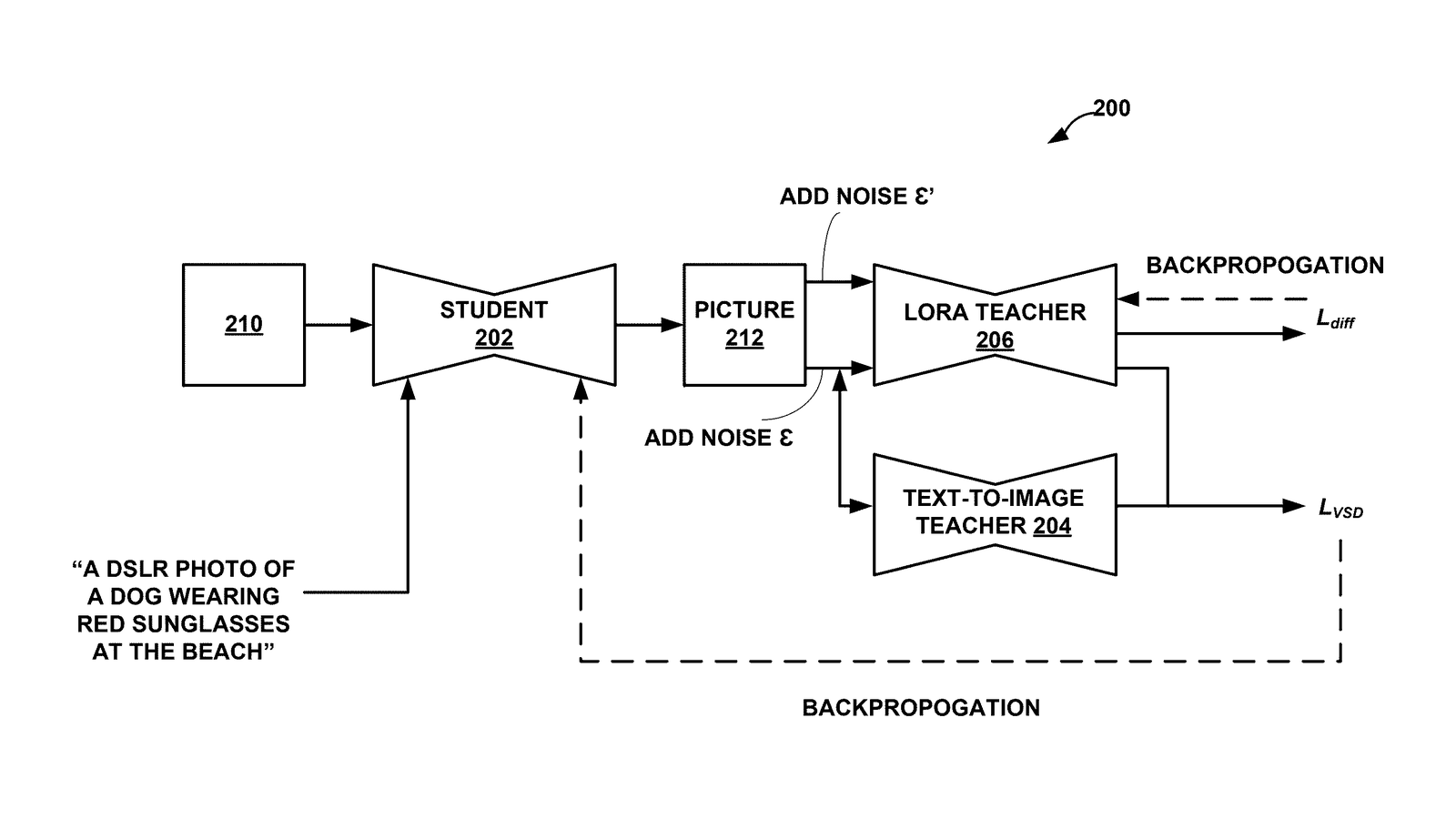
Qualcomm's patent application describes a middle path. It trains a few-step model, one that needs roughly 2 to 4 passes, by having it learn from more than one teacher model: a one-step model called SwiftBrush plus a slower, multi-step model.
The idea is to keep most of the speed while getting back some polish. The filing says the result can make better-looking images, such as people with correct anatomy, and says the training approach doesn't require image data.
How Qualcomm's student model learns from teachers #
The core claim is short: a device takes a prompt (usually text) and runs a few-step model to make the image. That model was distilled (trained by imitating bigger models, like a student learning from tutors) from a one-step teacher and at least one other teacher. In the filing, the one-step teacher is SwiftBrush, the other is a multi-step model, and a LoRA teacher (a small add-on model that helps the two teachers line up) can join in.
The model runs between 1 and 6 function evaluations (full passes through the neural network), with 2 to 4 being the range the filing highlights. During training, it is scored on four things:
- VSD loss : how far its output drifts from the multi-step teacher's sense of what a good image looks like.
- L1 loss : how closely it matches the one-step teacher's raw output.
- DISTS loss : whether its structure and texture look like the one-step teacher's to the eye.
- CLIP loss : whether the picture matches the words in the prompt.
To save memory, training applies the learning signal to only one randomly chosen step per prompt. Afterward, the model's weights are fused with the original one-step model's weights, and one example uses a 50/50 ratio.
In the filing's chart, the model scored best among public few-step models but did not beat the one-step SwiftBrush on some of the number scores.
Why fewer steps matter for AI picture tools #
If you've ever waited on an AI image app, that delay comes from how many passes the model makes. Fewer passes means quicker pictures and less computing per image, which matters most on a phone, where battery and heat are limits. The filing also says the model still works with editing and personalization tools, so the speed gain doesn't cost you those features. The filing names a smartphone as one example device, though it also lists tablets, cars, TVs and more. It is a patent application, so it shows what Qualcomm has described and says nothing about a product on the way. Still, the trade it tackles, speed against image quality, is one every AI picture tool has to make.
Qualcomm's 18th filing we've tracked in the AI photo editing race since July builds on earlier applications like one hiding parts of photos and one shrinking AI for phones.
The problem is real for anyone who has watched a progress bar while an AI draws. A wait that feels small becomes annoying when you tweak a prompt and try again, and on a phone every extra pass costs battery.
The fix fits the size of that problem. Landing at 2 to 4 passes keeps most of the speed and still lets editing tools work, which is a sensible target for everyday use.
The weak spot is evidence. The filing admits the model does not beat the one-step SwiftBrush on its own number scores, and the better-looking claim rests on visual judgment. The claims are also broad, covering any few-step model taught by a one-step teacher plus another teacher. Overall it is a useful refinement of a known technique, and a modest one.
Get our take in your Top Stories
Liked this breakdown? Add Patentlyze as a preferred source on Google, and our plain-English take shows up more often in your Top Stories the next time Qualcomm patent news breaks.
Add Patentlyze on GoogleOne click.
There are more where this came from
We read every patent application Big Tech publishes and send you the ones worth knowing. Plain English, free, every week.
The drawings #
6 drawing sheets from US 2026/0360036 A1 · click any drawing to enlarge
[Browse all the drawings 6 drawing sheets](https://docs.patentlyze.com/20260360036/page-01.png?v=1794523104)

    Want this weekly breakdown for a company we don't cover?
    [Patentlyze Pro →](https://patentlyze.com/pro/?src=post)
Source. Full patent text and figures from the
official USPTO publication PDF.