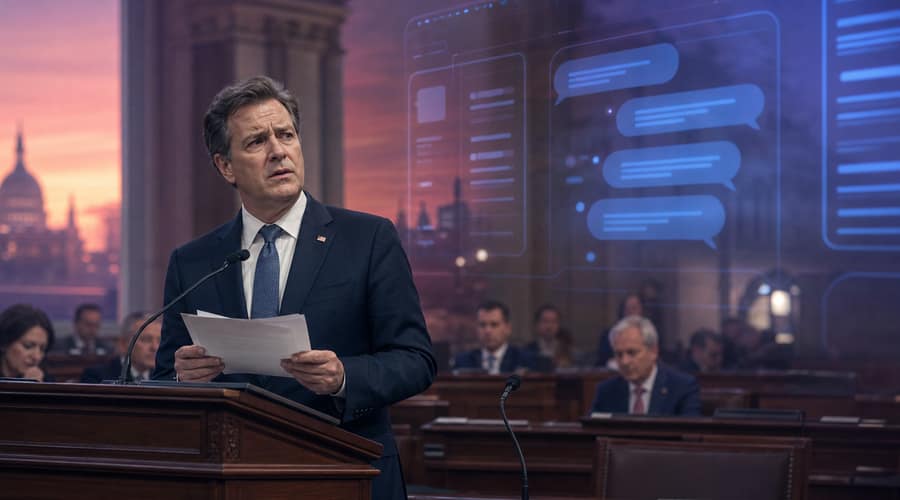
Progressive Conservative MLA Bill Oliver read what looked like a chatbot rewrite instruction into the New Brunswick legislative record. The joke is easy. The proofread failure is the real story.
The sentence Oliver read was not obscure. After saying, "Public confidence in the office of an advocate matters," he continued: "Here's a more natural, flowing version of that section that reads like a legislative speech rather than a series of short points." That isn't legislative language. It's the sort of wrapper line a chatbot gives you before the text you actually asked for. Oliver, a Progressive Conservative MLA for Kings Centre, read it aloud and kept going. Ars Technica and Futurism reported the clip on July 24 after it had started spreading on Reddit and Threads. It spread fast.
The instinct is to laugh at this, and plenty of people online did exactly that. But stop there and you miss what the incident is measuring. Oliver's mistake wasn't using AI to draft or polish remarks. That's now unremarkable. The mistake was putting copy in front of a legislature without reading it closely enough to catch the machine's stage direction. That's the tell.
Read the copy. The line doesn't make a factual claim about energy policy, health care, or the office of an advocate. It doesn't even pretend to be part of the speech. It says what the tool was asked to do. If you work with generative AI, you've seen this exact failure before: a stray "certainly," a prompt label, a suggested heading, a sentence that belongs to the exchange with the model rather than the document itself. In a private memo, it's sloppy. In Hansard, it's public evidence that the human review step failed.
According to the National Conference of State Legislatures, legislative staff are already using generative AI for drafting, proofreading, research summaries, transcription, legal research and templates. NCSL's June 2026 RELACS report said 55% of legislative staff in its latest survey were using generative AI tools for legislative work, up 11 percentage points from 2025 and more than double the 2024 level. It also said NCSL was aware of 38 legislative AI usage policies across 26 state legislatures. That is the useful context here. The issue isn't whether AI has entered legislative work. It has.
The issue is whether anyone is still owning the words.
This is not the first time a lawmaker has put AI-generated text into a chamber. In January 2023, Massachusetts congressman Jake Auchincloss read a ChatGPT-written speech on the U.S. House floor about a bill to create a U.S.-Israel artificial intelligence research center. The difference is that Auchincloss disclosed the stunt and used it to make a point about the technology. Oliver's version came three and a half years later as an accident. That gap is the story.
The rules are chasing the wrong failure #
Regulators are already moving toward AI disclosure, but most of the live policy work is aimed at visible synthetic content. The European Commission published its final voluntary Code of Practice on marking and labelling AI-generated content on June 10, 2026, and then published transparency guidance on July 20 for AI Act obligations that start applying on August 2. The rules cover things like informing people when they're interacting with AI and marking AI-generated or manipulated content in key cases. In the United States, Senators Brian Schatz, John Curtis and Mark Warner introduced the AI Labeling Act of 2026 in June, targeting covered AI-generated audio, video and images with visible and machine-readable disclosures.
Illinois gives you the same direction at state level. SB 2996, filed on January 29, 2026, would require qualified political advertisements generated in whole or substantially by artificial intelligence to carry a clear and conspicuous disclosure. The Illinois General Assembly record shows the bill was re-referred to Assignments on May 22. It hasn't solved the Oliver problem. It wouldn't. A prompt artifact in a floor speech isn't a campaign ad, a deepfake, or a synthetic robocall. It's ordinary prose moving through an office with too little friction.
Here's the thing: the next wave of AI governance will not be only about labels on fake videos. It will be about workflow. Who generated this paragraph? Who checked it? Was the model allowed to touch confidential material? Did anyone compare the final version against the brief, the bill, or the public record? Those questions sound dull until a legislator reads the chatbot's instruction line into the microphone. Then they sound necessary.
For founders building AI writing tools for government, law, finance, or enterprise clients, the product lesson is plain. Build the review trail before procurement asks for it. Keep the log. Show who drafted, who edited, who approved, and what changed. Give teams a way to catch prompt residue before it reaches a client, a court filing, or a legislature. That's not overcaution. It's where serious buyers are going. Oliver has not publicly explained the mistake. The clip already did. It showed how quickly AI assistance stops looking like an experiment and starts looking like office plumbing, quietly carrying words into public life until something clogs in plain sight.
Also read: Bluesky turns Attie into a social research tool and the open protocol is the whole point • xAI is shipping Grok 4.6 and 4.7 back to back in a release cadence no frontier lab has matched • The hedge funds that made 60% on the AI chip rally are now down 17% in July as $137 billion flees Asia