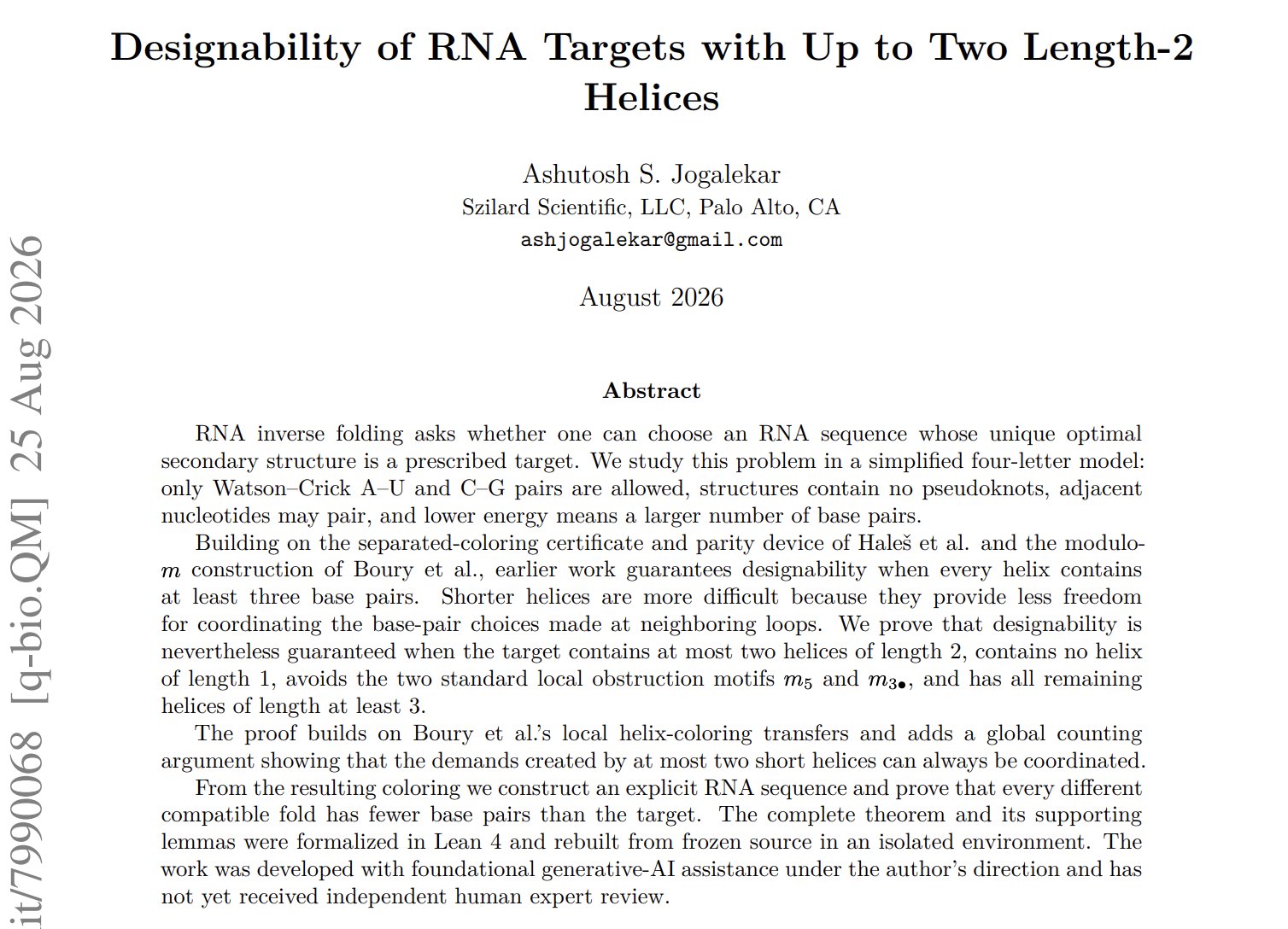
Ash Jogalekar on X: "I’m excited to share a new arXiv preprint. It is a modest but open theorem in theoretical biology proved by AI. (https://t.co/oAG7tBSA71): "Designability of RNA Targets with Up to Two Length-2 Helices"
Let me state the most important personal point upfront: *Without AI I could" I’m excited to share a new arXiv preprint. It is a modest but open theorem in theoretical biology proved by AI. (zenodo.org/records/221017…): "Designability of RNA Targets with Up to Two Length-2 Helices" Let me state the most important personal point upfront: Without AI I could not have done this. This is an AI-generated, human-directed, and formally verified mathematical proof. But I’m a chemist and biologist, not a mathematician or formal-methods expert, which is why, although I understand the problem, the approach and the results, I don't claim to understand every detail of the proof. I therefore tried to make the proof as AI-validated as possible: GPT/Codex (5.6 Sol, Ultra) and Claude Code (Opus 5, Max: Fable refused the prompts) were used in repeated adversarial review cycles. Codex was the workhorse; Claude provided valuable review and adversarial service. Fresh sessions were told multiple times to assume the proof was wrong and find the earliest failure. Early versions were rejected and repaired. Clarifications were asked at every step. Most importantly, the proof was formalized and verified in Lean. Among other things, this study revealed the value of different models complementing each other's strengths and weaknesses. Amusingly, the manuscript began from a place of jealousy! Mathematicians are increasingly using AI to attack theorems, while in chemistry and biology most important claims require experimental validation. I wondered whether there were chemical or biological problems that could be posed in a closed mathematical model and settled rigorously. That led me to the inverse RNA folding problem, akin to the inverse protein folding problem: given a target RNA secondary structure, can we choose a sequence for which that structure is the unique optimal fold? It turned out that there is in fact a modest but unproven subclass of problem in the field. Drawing on pioneering work by Haleš, Boury and others, we prove that every RNA target in a specified class - with up to two length-2 helices, no length-1 helices, all other helices at least 3, and two known local obstructions excluded - has a sequence for which that target is the unique maximum-pair, and therefore unique minimum-energy, fold. Chemically, it means that the target can be completely “filled” with pairing interactions; every alternative fold must use more pairs. At the heart of the proof is a three-color labeling of the RNA structure. Locally, the colors allow stems meeting at a loop to receive distinguishable nucleotide identities. Globally, a modulo-2 separation condition helps ensure that any alternative fold must lose at least one base pair. The proof constructs one definite sequence and establishes both parts of uniqueness: no competing fold of that same sequence can form more base pairs, and no different fold can form the same number. To check correctness, the construction examined tens of thousands of sequences that were dozens to hundreds of nucleotides long, but as with any good mathematical proof, the value of the theorem is in being general and extendable to an arbitrary number of sequences. The format of the manuscript turned out to be a little tricky. The core mathematical proof is 13 pages, but that paper would have been incomprehensible to non-mathematicians and maybe read by five mathematicians or computer scientists in the world. I wanted to make sure that the paper was of more general interest and the main message could be grasped by biologists, chemists and physicists. This did lead to the paper being expanded to almost 40 pages and needed multiple cycles of review and tweaking, but I think that's much better for a broader audience. This is a rigorous positive result in an open regime of theoretical biology, and for me, a striking example of what AI can make possible for scientists who understand a domain problem but are not trained mathematicians. The novelty is not the theorem itself but the process of AI proof generation and rigorous verification. AI helped translate a domain problem I understood into combinatorial arguments, exact computational tests, and a complete formalization. Spread out over a month or so, this project was a great experience for me, and it really revealed the sense of what a human working in tandem with an AI feels like. The preprint has not yet undergone independent human expert review. I am sharing it transparently and welcome careful criticism from experts. Whether the AI is proven right or wrong - and perversely it would be even more interesting if the proof is wrong, given the number of adversarial cycles I put it through - I would be delighted either way, and there would be much to learn. As the great Enrico Fermi once said, "If your experiment works, you have confirmed your hypothesis. If it fails, you have made a discovery." GitHub: github.com/ajogalekar/rna… Zenodo: doi.org/10.5281/zenodo… arXiv: Will post public link once it's available. You can read the paper at the Zenodo link. @OpenAI@claudeai@AnthropicAI
I’m excited to share a new arXiv preprint. It is a modest but open theorem in theoretical biology proved by AI. (zenodo.org/records/221017…): "Designability of RNA Targets with Up to Two Length-2 Helices" Let me state the most important personal point upfront: Without AI I could not have done this. This is an AI-generated, human-directed, and formally verified mathematical proof. But I’m a chemist and biologist, not a mathematician or formal-methods expert, which is why, although I understand the problem, the approach and the results, I don't claim to understand every detail of the proof. I therefore tried to make the proof as AI-validated as possible: GPT/Codex (5.6 Sol, Ultra) and Claude Code (Opus 5, Max: Fable refused the prompts) were used in repeated adversarial review cycles. Codex was the workhorse; Claude provided valuable review and adversarial service. Fresh sessions were told multiple times to assume the proof was wrong and find the earliest failure. Early versions were rejected and repaired. Clarifications were asked at every step. Most importantly, the proof was formalized and verified in Lean. Among other things, this study revealed the value of different models complementing each other's strengths and weaknesses. Amusingly, the manuscript began from a place of jealousy! Mathematicians are increasingly using AI to attack theorems, while in chemistry and biology most important claims require experimental validation. I wondered whether there were chemical or biological problems that could be posed in a closed mathematical model and settled rigorously. That led me to the inverse RNA folding problem, akin to the inverse protein folding problem: given a target RNA secondary structure, can we choose a sequence for which that structure is the unique optimal fold? It turned out that there is in fact a modest but unproven subclass of problem in the field. Drawing on pioneering work by Haleš, Boury and others, we prove that every RNA target in a specified class - with up to two length-2 helices, no length-1 helices, all other helices at least 3, and two known local obstructions excluded - has a sequence for which that target is the unique maximum-pair, and therefore unique minimum-energy, fold. Chemically, it means that the target can be completely “filled” with pairing interactions; every alternative fold must use more pairs. At the heart of the proof is a three-color labeling of the RNA structure. Locally, the colors allow stems meeting at a loop to receive distinguishable nucleotide identities. Globally, a modulo-2 separation condition helps ensure that any alternative fold must lose at least one base pair. The proof constructs one definite sequence and establishes both parts of uniqueness: no competing fold of that same sequence can form more base pairs, and no different fold can form the same number. To check correctness, the construction examined tens of thousands of sequences that were dozens to hundreds of nucleotides long, but as with any good mathematical proof, the value of the theorem is in being general and extendable to an arbitrary number of sequences. The format of the manuscript turned out to be a little tricky. The core mathematical proof is 13 pages, but that paper would have been incomprehensible to non-mathematicians and maybe read by five mathematicians or computer scientists in the world. I wanted to make sure that the paper was of more general interest and the main message could be grasped by biologists, chemists and physicists. This did lead to the paper being expanded to almost 40 pages and needed multiple cycles of review and tweaking, but I think that's much better for a broader audience. This is a rigorous positive result in an open regime of theoretical biology, and for me, a striking example of what AI can make possible for scientists who understand a domain problem but are not trained mathematicians. The novelty is not the theorem itself but the process of AI proof generation and rigorous verification. AI helped translate a domain problem I understood into combinatorial arguments, exact computational tests, and a complete formalization. Spread out over a month or so, this project was a great experience for me, and it really revealed the sense of what a human working in tandem with an AI feels like. The preprint has not yet undergone independent human expert review. I am sharing it transparently and welcome careful criticism from experts. Whether the AI is proven right or wrong - and perversely it would be even more interesting if the proof is wrong, given the number of adversarial cycles I put it through - I would be delighted either way, and there would be much to learn. As the great Enrico Fermi once said, "If your experiment works, you have confirmed your hypothesis. If it fails, you have made a discovery." GitHub: github.com/ajogalekar/rna… Zenodo: doi.org/10.5281/zenodo… arXiv: Will post public link once it's available. You can read the paper at the Zenodo link. @OpenAI@claudeai@AnthropicAI