AI Infra Summit 2026 Data centers account for a quarter of projected load growth in the state, its grid operator said, against much larger shares in Texas and Virginia.
Akul Saxena
SANTA CLARA, Calif., Sept. 15, 2026 – Six federal proceedings opened in June will set the terms for how data centers connect to the American power grid and who pays for the transmission built to serve them. The six grid operators named in them file responses this fall.
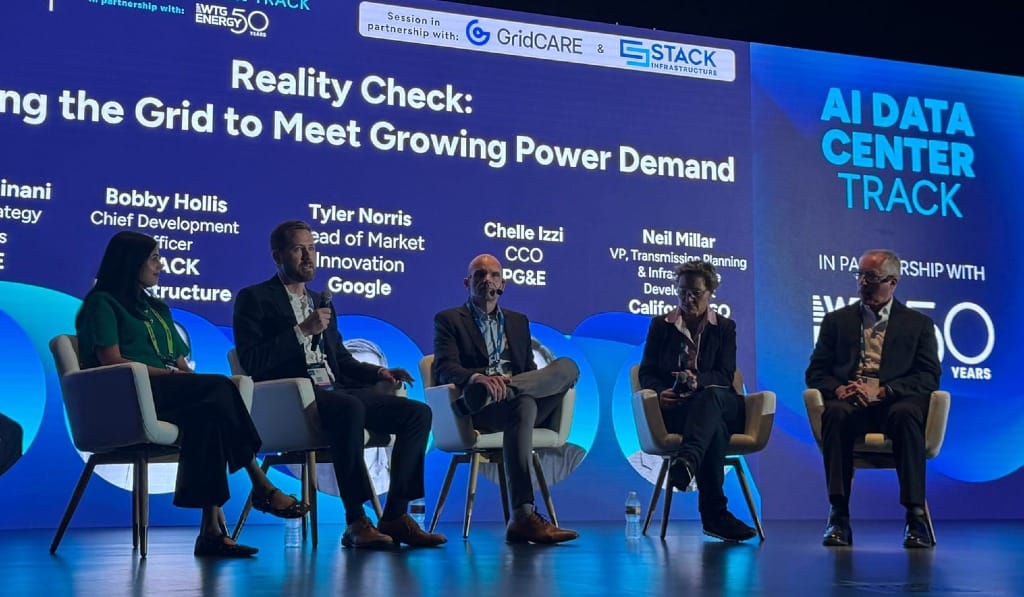
The AI Energy Management Alliance, a new trade association for artificial intelligence power demand, launches Wednesday, said Tyler Norris, head of market innovation at Google. It was formed to file comments in regulatory proceedings, which he said the industry's existing group does not do.
The Federal Energy Regulatory Commission, which regulates interstate electricity transmission, opened the proceedings under Section 206 of the Federal Power Act. That provision lets the commission find a utility's tariff, the rates and terms it must charge, unjust and unreasonable, and order the operator to file new terms.
The orders require each operator to address cost shifting onto other ratepayers, the rules for studying an application, generation built alongside a facility to serve the data center, and a class of service for customers that can cut demand on request. All five federal commissioners concurred.
The bill on the East Coast
Data centers account for $29.4 billion of the $63.6 billion in capacity charges from the last four annual auctions run by PJM Interconnection, the grid operator for 13 states and the District of Columbia. Those auctions pay generators to stay available for the hours when demand peaks.
PJM stands for Pennsylvania, Jersey, and Maryland.
That accounting comes from Monitoring Analytics, the independent monitor of PJM's markets, which put the data center share of total energy consumption at 46 percent. PJM is one of the six operators now under order.
A market that went national
Data centers used to cluster in three places. Northern Virginia, California and Hillsboro, Ore., were the mature markets, where the utilities had connected them before, said Bobby Hollis, chief development officer at STACK Infrastructure, which builds data centers and leases them to cloud companies.
Artificial intelligence made the market national, he said, since reaching the scale and demand hyperscalers required was simply too slow in the existing clusters.
Northern California is one of those markets, and Pacific Gas and Electric is the investor-owned utility that serves the region. Requests to connect data centers and other very large customers there have grown from one or two gigawatts to more than 10, said Chelle Izzi, the company's chief commercial officer. One gigawatt is roughly the output of a large nuclear reactor.
Izzi is PG&E's first chief commercial officer, a post created to pursue what the company calls rate-reducing load growth. Whether that works depends on how fast the utility can connect anyone. "We can't hire folks fast enough to do transmission planning," she said, adding that there are simply not enough people anywhere with the skill to plan transmission systems.
Developers now ask for hundreds of megawatts within a couple of years up from the 10 or 20 megawatts a conventional facility once needed, Hollis said, and what the industry wants is the equivalent of a major city built overnight and then run in a way no city runs.
Where California sits
Data centers account for roughly 25 percent of projected load growth here over the coming decades, said Neil Millar, vice president of transmission planning and infrastructure development at the California Independent System Operator, the nonprofit that runs the electricity market for about 80 percent of the state. That share is lower than in Texas or Virginia since California was already connecting electric vehicles and building electrification before any data centers arrived.
Average hourly demand across the year runs about 55 percent of the state's peak, Millar said, which means much of the grid exists to cover a few hundred hot afternoons. California has added almost 30 gigawatts of installed capacity since 2020 and has studied connection requests in batches since 2008, and Millar said its sixteenth such batch opened and closed in six months.
PG&E has been directing customers to where capacity already exists. The utility published where it had room and steered demand away from a constrained corridor around San Jose, a few miles from the conference, and about 80 percent of applications now sit where that capacity is, Izzi said.
Generation solved, transmission not
Google has announced about a gigawatt of demand response across its American data centers. The ‘demand response’ entails cutting consumption during the hours when the grid is tightest supply, Norris said. Most of that comes from training, the work of building a model, which Google can delay or run at a different site. Answering a user's question, called inference, is harder to relocate, since the request must be made with the lowest latency possible.
Flexibility of that kind solves an electricity generation problem, Norris said, as it spares the grid from firing up another plant at the peak. It does not solve the transmission problem, which can keep a customer waiting years for a connection.
Norris said California could free roughly 20 gigawatts of transmission capacity through remedial action schemes, equipment that automatically disconnects a customer within seconds when a line or a piece of equipment fails.
Rules for data centers should protect the households and businesses sharing the same transmission lines, Millar said, because "every other objective falls away if the lights are not staying on."