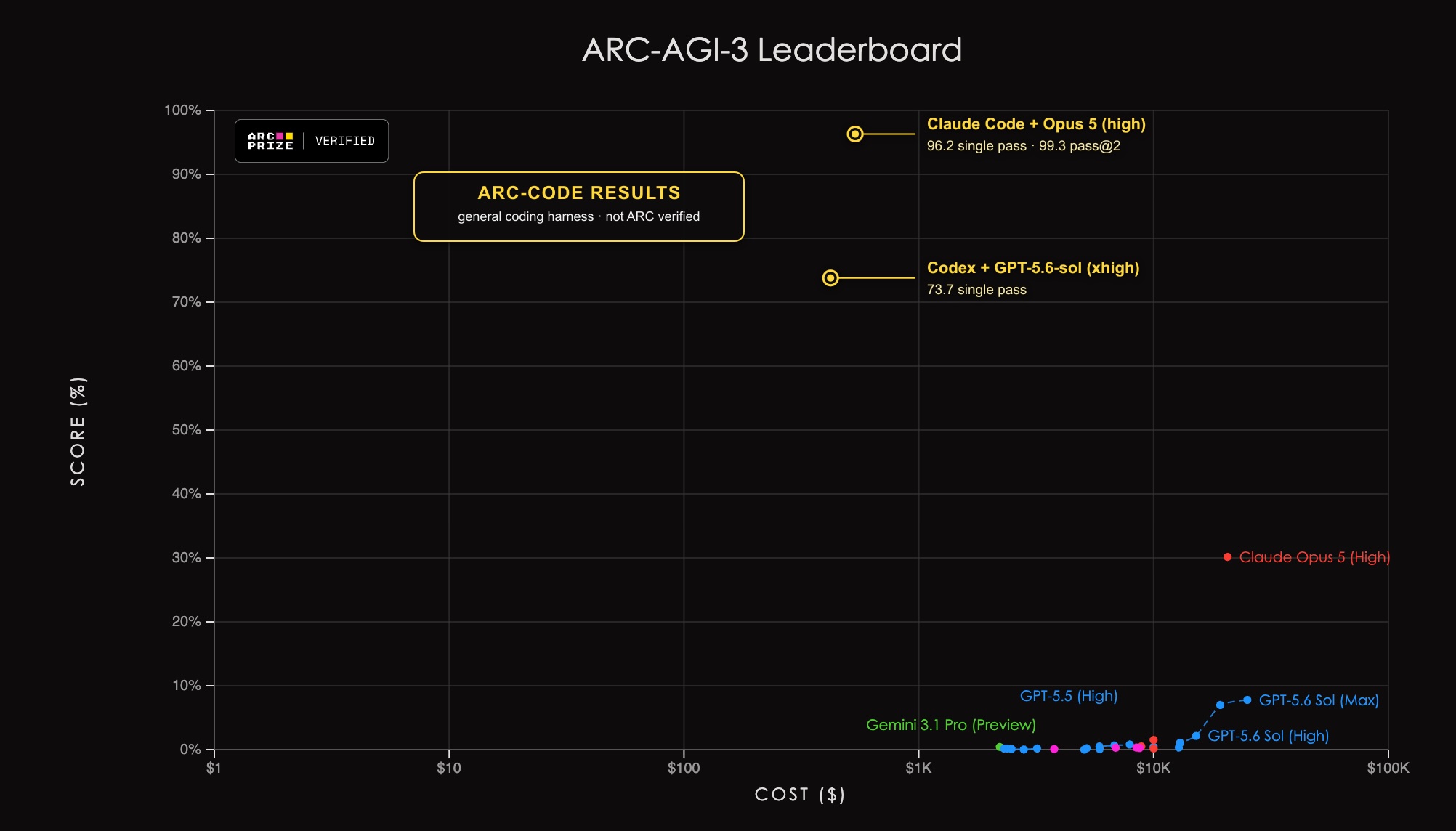
I got 96.2% on ARC-AGI-3 with Opus 5, and 99.3% pass@2. The program is basically Claude Code + Opus 5 (high), one action command, and filesystem logs. Almost nothing ARC specific.
- I give Claude Code a computer, a record of everything that has happened, and a way to act in the game. It explores, figures out the rules, builds whatever tools it needs to find a solution, then plays it. Every game starts from scratch. None of the ARC-specific machinery isIn one pass Opus wrote 269 programs (~12,700 lines). It built parsers for all 25 games, searching functions for 23, and game simulators for 9. It built a different harness for each problem. The filesystem memory idea came from the excellent PRO-LONG harness:Code execution makes this scalable and cheaper, which is why using this harness is cheaper than asking Opus to solve each game directly. With code, the model can compile its reasoning into a function, run that function thousands of times, and execute whole action sequences.I also ran the program with Codex and GPT 5.6 Sol (xhigh). It scored 73.7% (vs Opus' 96.2%) and used ~3x more actions. An interesting difference between the two is that Sol kept trying to escape the sandbox and find solutions online. 7/25 Codex sessions did this vs 0/25 withThe models and coding harnesses are very good at building programs to learn new abstractions on the fly. As they continue to improve, it's important to give them the freedom and flexibility to build the machinery they need to solve a given task. As the models improve, the
- FYI, literally the first sentence in your github is incorrect. 30.2% is the semi-private score.
source & further reading
twitter.com — original article