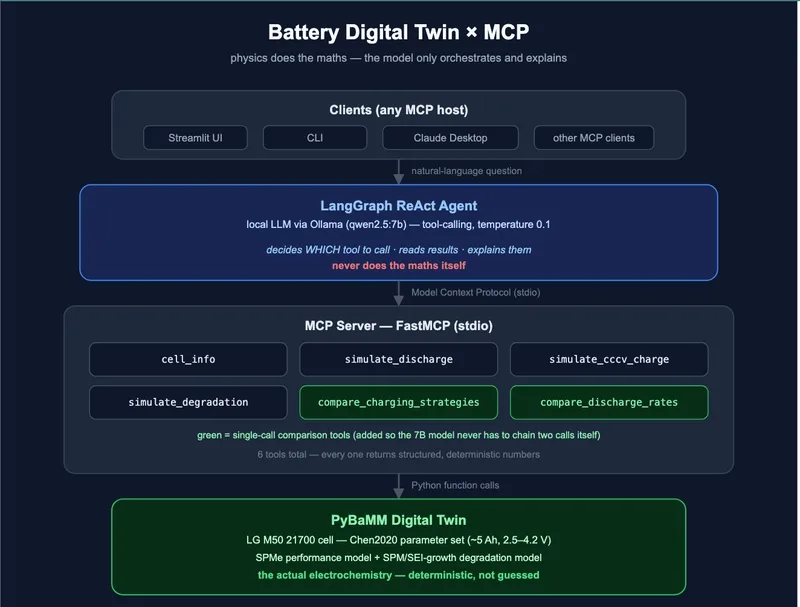
The setup: a PyBaMM digital twin simulating an LG M50 21700 cell, wrapped as six MCP tools over stdio. A LangGraph ReAct agent backed by qwen2.5:7b
via Ollama picks the tools and narrates the results.
The six tools:
— static cell descriptioncell_info
— constant-current discharge (runtime, capacity, energy)simulate_discharge
— CC-CV charge (charge time, energy input)simulate_cccv_charge
— ranks multiple charge rates in one callcompare_charging_strategies
— compares multiple discharge rates in one callcompare_discharge_rates
— capacity fade over N cycles via SEI growthsimulate_degradation
Single-tool questions worked great from day one. Ask "how long at 1C?" and the agent calls
simulate_discharge(c_rate=1.0)
, reads the result, and answers. Reliable.The break came with comparisons. Ask "2C versus 0.5C" and the natural ReAct pattern is two sequential simulate_discharge
calls — one per rate. On qwen2.5:7b
, this reliably failed. The model would chain one call, get the result, then either stop or hallucinate a second answer. No error thrown — just a confident, well-formatted response missing half the data. Exactly the kind of quiet failure the physics-grounding was supposed to prevent, just moved up one layer from number generation to tool orchestration.
It wasn't the only rough edge. llama3.1:8b
at one point printed tool calls as literal JSON text instead of invoking them, so no simulation ran at all — that's what pushed me to qwen2.5:7b
. Separately, the agent would sometimes speculate about why a number looked a certain way: labeling delivered capacity above the 5.0 Ah nominal rating as "inefficiency" or "over-discharge" when running above nominal capacity at gentle rates is just normal cell behavior.
The root issue isn't model size — it's planning horizon. A two-call comparison isn't one decision; it's several in sequence: call tool A, hold its result in context, decide to call tool B with different arguments, hold that result too, then reason over both. That's a chain the 7B model loses track of.
The fix was collapsing comparison logic into single-call tools. Instead of asking the model to chain simulate_discharge
twice, I built compare_discharge_rates
and compare_charging_strategies
to run multiple simulations server-side and return a ranked result. The model now makes one call, gets a complete answer, and there's no multi-step planning to fail.
The prompt I use for the agent:
You are a battery engineering expert assistant. You have access to simulation tools that run real electrochemical models. Always use the appropriate tool for the question asked — never guess at numbers. If a comparison is needed, use the comparison tools. Only speculate about results after you have the data. Keep answers concise and grounded in the simulation output.
This isn't just about smaller models — it's about designing tools that match the planner's actual capacity. Every tool I build now goes through the same filter: what's the minimum number of sequential calls a 7B model can reliably chain? If the answer is more than one, I fold the logic into the tool itself.
Next How to Spot the Real GigaChat (and Avoid the Fakes Draining Your →