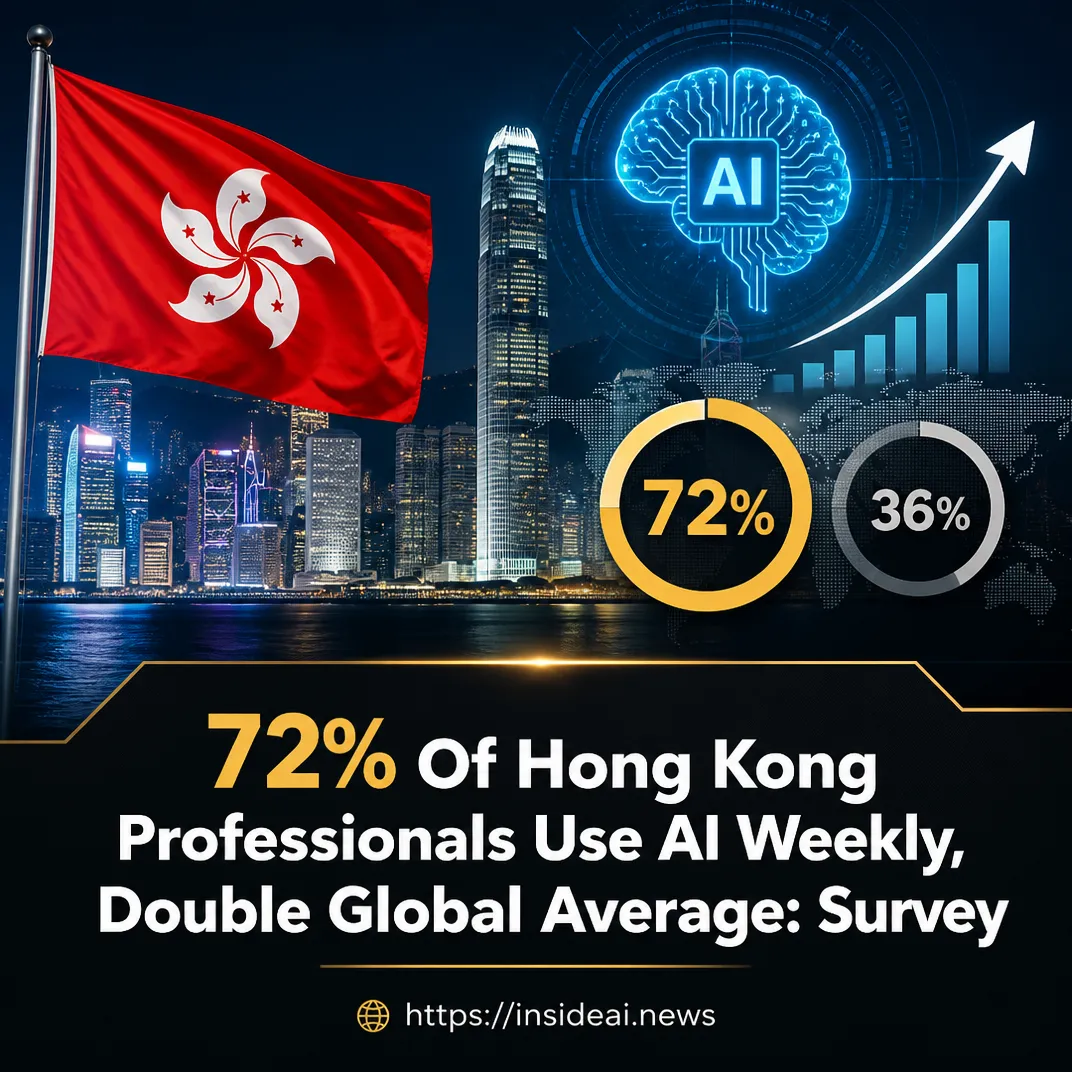
August 10, 2026, (Inside AI) — A striking 72.7% of Hong Kong professionals now use AI tools on a daily or weekly basis, more than double the global average of 31%, according to a new survey by the Hong Kong University of Science and Technology (** HKUST**). The study, which polled 3,722 working professionals between March and April this year, reveals a city racing ahead in AI adoption but also exposes a sharp divide in how different ranks perceive the technology’s impact on their careers.
The global benchmark comes from a 2025 KPMG study, underscoring Hong Kong’s outlier status. Generative AI tools like ChatGPT, Copilot, and Gemini dominate, with 81.7% of respondents using them primarily for drafting documents, summarizing information, and supporting creative work. Yet this widespread uptake masks a more complex reality: only about a quarter of professionals regularly engage with advanced AI applications such as data analytics, image or video generation, or agentic systems capable of multi-step autonomous tasks.
The survey’s demographic tilt is notable. Over 60% of participants were aged 30 to 49, a cohort often balancing mid-career demands with technological adaptation. Their embrace of AI tools suggests a pragmatic integration into daily workflows, but the data also surfaces a troubling undercurrent of anxiety among junior staff.
AI’s Two-Tier Impact on Hong Kong’s Workforce #
While about 70% of senior managers reported that AI boosted their motivation to learn new skills, the sentiment flipped for junior employees. More than half of junior-level respondents feared AI could erode the value of their existing skills, and approximately 40% said it left them feeling less secure in their jobs. This chasm in perception points to a potential fault line in organizational AI strategies: leadership may see empowerment, while frontline workers sense displacement. “More than half of junior-level employees said they worried AI could erode the value of their existing skills,” the survey noted, highlighting a psychological toll that could affect productivity and retention. The findings echo broader global concerns about AI-driven job displacement, but Hong Kong’s accelerated adoption rate amplifies the urgency. The city’s status as a financial and tech hub, combined with a dense, competitive labor market, may be intensifying these dynamics.
The limited use of advanced AI tools is another critical data point. Despite high overall adoption, the gap between basic generative AI and more sophisticated applications suggests a workforce still in the early stages of AI maturity. This pattern aligns with historical technology adoption curves, where initial enthusiasm for accessible tools often precedes deeper integration. However, for a city positioning itself as a smart technology leader, the lag in advanced usage could hinder long-term competitiveness.
Industry observers note that Hong Kong’s unique business environment, characterized by a high concentration of SMEs and a fast-paced service economy, may be driving the rapid uptake of simple AI tools for efficiency gains. Yet without upskilling initiatives that target advanced capabilities, the current boom could plateau. The survey’s timing, just months after the global AI surge of 2025, captures a moment of both opportunity and risk.
Comparatively, other Asian tech hubs like Singapore and Shenzhen are also seeing AI adoption spikes, but Hong Kong’s rate stands out. A 2024 study by the Hong Kong Productivity Council had already flagged growing AI interest among local businesses, but the HKUST data provides the most granular view yet of individual professional behavior. The emotional dimension, particularly junior staff anxiety, adds a new layer to policy discussions around AI governance and workforce transition.
The survey’s release comes as Hong Kong’s government pushes forward with its AI development strategy, which includes funding for research and talent cultivation. But if the workforce is psychologically unprepared, even the best-laid plans could face resistance. Companies may need to pair technology rollouts with transparent communication and reskilling pathways to bridge the confidence gap between senior and junior staff.
Looking ahead, the HKUST findings could serve as a baseline for tracking AI’s evolving impact on Hong Kong’s labor market. The survey’s focus on weekly usage, rather than mere awareness or occasional use, sets a high bar that other regions might adopt. As AI tools become more embedded, the real test will be whether the initial productivity gains translate into sustainable career growth for all levels, or merely widen the existing divides.