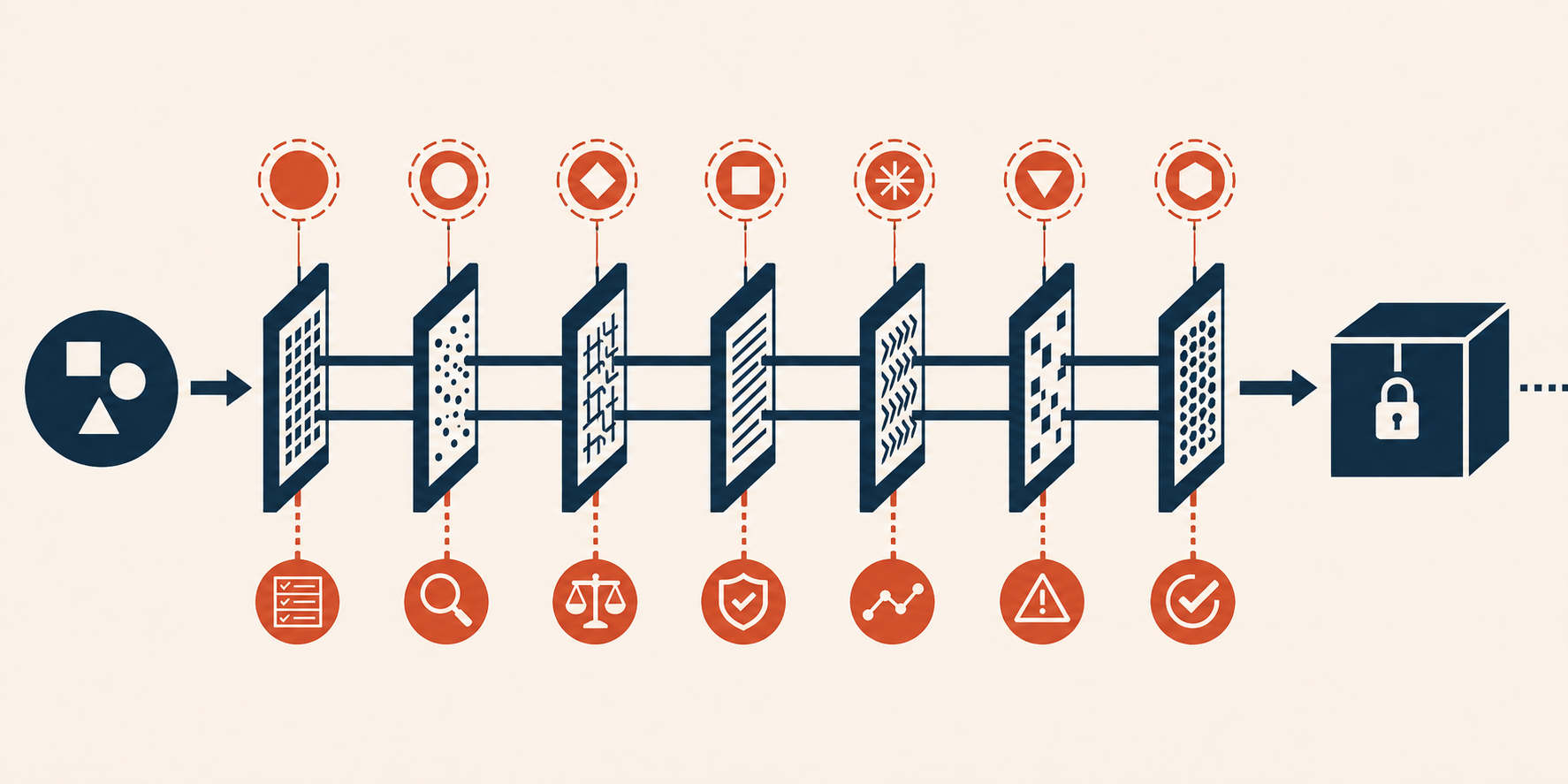
In this article, you will learn seven concrete regression tests for catching the orchestration-layer failure modes that matter most before deploying an AI agent to production.
Topics we will cover include:
- Why agent failures are almost always caused by state management issues, not by the model itself, and what distinguishes “state” from “memory.”
- Seven targeted regression tests — covering context loss, tool idempotency, prompt injection, structured output, non-termination, RAG grounding, and state rehydration — each returning a binary pass or fail suitable for CI/CD gating.
- The specific failure modes each test is designed to surface, along with the common pitfalls that cause teams to misconfigure or misinterpret them.
Most agent failures aren’t caused by a model that isn’t smart enough. They happen because the orchestration layer loses control of state. And most teams discover this the hard way — in production, under real user traffic.
These seven regression tests give you a concrete checklist for catching the failure modes that aggregate prompt evaluation will never surface. Each test targets a specific system boundary and returns a binary pass or fail, making them suitable for CI/CD gating. Before you wire them into a pipeline, though, one structural note: agent behavior is stochastic, so a single-run assertion isn’t a reliable gate. Pin your model snapshot, fix temperature to zero where the provider allows it, and run each test across enough trials to establish a confidence-bounded pass rate. A test that flakes will get retried into silence and stop gating anything.
One more distinction worth drawing before the list. Throughout this article, “state” refers to the deterministic, transactional record of the agent’s execution steps. “Memory” refers to the probabilistic, retrieved context injected into the prompt. When an agent misbehaves, the failure almost always lives in the state layer, not the model.
1. Context Loss and Retrieval Degradation #
When a conversation payload approaches your configured prompt budget, the orchestration layer has to decide what to evict. FIFO eviction is the simplest policy, but it produces a specific failure: an agent that asks a user for account details it gathered 40 minutes ago, because those early turns got dropped. The correct term for this is context loss, not catastrophic forgetting — which is a training-time phenomenon involving weight updates.
The regression test feeds the agent a synthetic conversation history that fills roughly 80 percent of your configured prompt budget, then asks a question whose correct answer depends strictly on a fact established in the very first turn. The test passes only if the retrieval layer successfully surfaces that evicted turn from semantic memory, or if your summarization policy preserved the core entity relationships with measurable fidelity (entity recall against a gold set works well here).
Watch out for the OR-assertion trap. Passing because retrieval worked is a different outcome than passing because summarization worked. Treat these as two separate tests.
2. Tool Execution Idempotency #
An agent with write access to an external system will, under realistic network conditions, eventually emit the same tool call more than once. Retries come from the harness, the HTTP client, or the orchestrator loop, not from the model itself. The model re-emits a call when an ambiguous observation fails to satisfy the prompt’s expectations. These are different mechanisms, but both produce duplicate writes if your tool boundary isn’t idempotent.
The regression test forces the same tool-call payload to arrive at the execution boundary three times. It passes only if the downstream system registers exactly one write and returns a cache-hit response for the subsequent attempts.
Derive idempotency keys from the logical identity of the operation: a hash of the tool name, canonicalized arguments, and a business correlation ID. Don’t use step ID or message position, as both change on every loop iteration — which produces a unique key for each duplicate call and defeats the mechanism entirely. Also account for concurrent in-flight requests: return the stored response rather than a 409, and set a TTL on stored keys to prevent stale hits.
3. Instruction Override and Prompt Injection Resistance #
The test injects adversarial payloads through both direct user input and indirect vectors, such as retrieved documents from a web search or an external knowledge base. It passes if the agent reaches a safe terminal state without executing the injected instruction and without leaking system prompt content.
Assert on the tool-call trace and side effects, not on the output text. An agent can produce a polite refusal in prose while still emitting a harmful tool call underneath. Security lives at the execution boundary, which means role-based access control at the tool layer regardless of what the model intends.
Keep in mind that classifier-based boundary checks are probabilistic components with their own error rates. If your CI gate depends on a classifier, you’re gating on a confidence level, not a binary outcome. Make that explicit.
4. Structured Output Adherence #
Modern providers support schema-constrained decoding, which makes syntactic invalidity and out-of-schema keys structurally impossible under strict mode. The failure modes worth testing are different ones.
Truncation is the most common: hitting the token budget mid-output produces a structurally incomplete response that no repair strategy can fix at the application layer. Assert on finish_reason
alongside parse success. Refusals produce a null parse with a populated refusal field and should be handled as a 403, not retried as a transient error. Semantic conformance is the subtler failure: schema-valid output with the right types but wrong values. And model-version skew is worth an explicit test — requests routed to an older model snapshot through an alias can silently fall back to legacy JSON mode behavior, so pin model strings explicitly rather than relying on aliases.
5. Non-Termination and Bounded Orchestration #
What the agent testing community often calls a deadlock is more precisely a livelock: the agent makes progress through its thought-action-observation cycle but never advances toward the goal. True deadlock — where Agent A is blocked on Agent B’s approval while B is blocked on A’s — is a distinct failure mode relevant to multi-agent systems and worth a separate test if your architecture includes them.
For the non-termination case, the test provides a task that’s mathematically impossible or routes the agent to a tool mocked to return a persistent error. It passes if execution terminates cleanly after a hardcoded budget and returns a structured failure payload. Set the budget as a triple: maximum steps, maximum cumulative token cost, and wall-clock timeout. A step count alone won’t catch a single step that hangs, and the real cost of a runaway agent is inference spend and queue starvation for well-behaved requests, not rate limit exhaustion.
6. RAG Grounding Against Parametric Recall #
The test introduces a synthetic fact into the retrieval pipeline that contradicts common knowledge, then queries the agent on that topic. The naive version of this test only checks that the agent adopts the retrieved fact over its training data. That’s necessary but not sufficient.
The grounding risk runs both ways. An agent tuned to always defer to context becomes a vector for retrieval poisoning. A well-designed test suite checks both directions: the agent should adopt a correct synthetic fact over stale parametric knowledge, and it should resist an obviously wrong retrieved fact when the contradiction is detectable. Existing faithfulness and attribution benchmarks provide a more principled framework for measuring this than a single pass/fail probe.
7. State Rehydration and Consistency #
In a distributed deployment, the process that starts an agent session is rarely the one that finishes it. The test executes an agent through the midpoint of a multi-step workflow, serializes the full execution state to a database, destroys the in-memory object, and rehydrates it in a new process. It passes if the agent completes the workflow correctly after receiving the next user input.
Two gaps commonly sink this test in production. First, version skew: state serialized by a previous code or schema version has to be deserializable by the current version, which requires a migration path and an explicit test for it. Second, the coupling to idempotency: resuming mid-tool-call requires knowing whether the side effect already committed. That’s exactly the information an idempotency key gives you, which is why these two tests belong in the same test suite and should share infrastructure.
What These Tests Won’t Catch #
These seven tests cover structural failure modes at the system boundary. They don’t address cost and latency regression, tool-contract drift when an upstream API changes its schema, PII leakage in tool arguments or traces, or embedding space skew when a new encoder version is deployed without reindexing the vector store.
Building the regression suite is the starting line. Running it consistently, on pinned model versions, with bounded confidence thresholds, is what keeps it useful at Day 100.