There is a game I wanted to build: a star sign guessing oracle that figures out your Western zodiac in 2–3 questions, with no birthday asked. Before writing a single line of code, I asked six different AI chatbots the same open-ended design problem.
The prompt: Design a game that guesses the user’s Western star sign. Use the fewest questions. Show the fewest zodiac images. No birthday cheating.
What came back was one of the most interesting cross-AI comparisons I have run. Same problem. Completely different instincts.
The Math That Governs Everyone #
Before the strategies, here is the hard constraint every AI had to work around. There are 12 zodiac signs. A pure yes/no question delivers exactly 1 bit of information. The information needed to identify one sign out of twelve is log₂(12) ≈ 3.58 bits.
This means a minimum of 4 yes/no questions are needed — unless you ask a question with more than two options, which delivers more bits at once. That loophole became the battleground.
Grok: The Magic Card Trick #
Grok came at this like a magician, not a game designer. It numbered the 12 signs 0–11, then assigned each a 4-bit binary code. Four cards are shown to the user, each containing 6 signs. The user answers yes/no to each card. The sum of the card values decodes uniquely to the correct sign.
Exactly 4 rounds. Exactly 6 images per card. 100% accurate. It is the same logic as those “I can guess your number” birthday card sets from primary school — pure binary encoding dressed up as mysticism.
The problem: scanning 6 signs per question is a lot of visual work for the user. And the experience feels mechanical — you can sense the algorithm underneath. But as a mathematical solution, it is clean and undeniable.
Doubao: Most Rigorous on Paper #
Doubao gave the most mathematically thorough response. It formally separated questions into two types — text-only questions (zero images, using date boundaries like “born before June 22?”) and image-set questions (show K signs, ask yes/no). It then proved why some branches cannot be split evenly using date boundaries alone.
The insight: Cancer, Leo, Virgo, Libra, Scorpio, and Sagittarius cannot be cleanly halved by any single calendar cut. You have to use an image group question to get an even 3-3 split. Doubao’s solution handles this correctly, achieving 4-round worst case with a peak of 3 images shown at once.
Rigorous. A little dry. The kind of answer you would get from a very good engineering student who has read the textbook but not yet shipped a product.
DeepSeek: The Fast-Path Gamble #
DeepSeek opened with a surprising first move: show only 4 signs in round one — Leo, Virgo, Libra, Scorpio — and ask if the user’s sign is in that group. If yes, the user is locked into a 4-candidate branch and done in 3 rounds. If no, 8 candidates remain, and worst case becomes 5 rounds.
This trades worst-case rounds for a better experience for a subset of users. About 33% of users breeze through in 3 rounds with a small first card. The other 67% take longer. Average: 3.67 rounds. DeepSeek framed this as a feature — the Leo user who gets a fast answer feels like the oracle is clairvoyant.
The tradeoff is real and honest. DeepSeek was the only AI that openly acknowledged it is making a gamble on user distribution.
ChatGPT: The Meta-Answer #
ChatGPT responded by naming the actual problem more clearly than the others. It identified three competing objectives — minimum rounds, minimum images shown, minimum cognitive effort — and pointed out that optimizing for one hurts the others. Four rounds with 11 images total is not the same as five rounds with 6 images total.
It then proposed “born in the first half of the year” as a free zero-image first question, followed by adaptive star card sets. The end experience: images only appear partway through, and the final reveal is just one sign on screen.
ChatGPT was thinking about the emotional arc of the game rather than just the decision tree. That is a different kind of intelligence than pure optimization — and arguably more useful for a product that needs to feel magical, not efficient.
Gemini: Two Answers, One Genius Moment #
Gemini gave two separate proposals, and the second one was the wildest of the batch.
The first proposal: design one beautiful star chart with 4 visual dimensions — inner/outer ring, gold/silver color, circle/diamond border, star trail or none. Four visual attributes, each with two options, gives 2⁴ = 16 states. Assign 12 signs to 12 of those states. One image stays on screen throughout. Four questions ask only about what the user sees on their own sign. Zero image-switching. The whole game uses a single picture.
The second proposal was the one that stopped me: a 4×3 orthogonal matrix. Question one has four options (three groups of 3 signs, plus one “not in this image” option). Question two has three options (two groups plus “not here again”). That gives 4 × 3 = 12 states — exactly enough to uniquely identify all 12 signs. Two rounds total. Two images total.
And here is the viral moment Gemini designed for Pisces users: round one shows 9 signs — they cannot find Pisces and click “not in this image.” Round two shows 8 signs — still no Pisces. They click “not here again” a second time in confusion. Then the reveal: “You found no home in either vision. The cosmos knew — you were always Pisces, hiding in the deep.”
A user who never sees their own sign on screen, and gets correctly identified anyway — that is the moment people share.
Kimi: Mathematically Proven Optimal #
Kimi did not just give an answer. It showed why three rounds are enough.
The argument: under our rules — first question has four options, remaining questions are yes/no, no direct birthday asking — a season selector delivers log₂(4) = 2 bits at once. Two yes/no questions add 1 bit each. Total: 4 bits, which covers log₂(12) ≈ 3.58 bits needed to identify one sign from twelve. Three rounds are enough. Not the absolute floor for all possible game designs, but the minimum under these specific rules.
The structure: pick spring/summer/autumn/winter → narrows to 3 signs → one sign shown as a card (“is this you?”) → if no, a second sign shown → if no again, the third is inferred without ever appearing on screen.
Worst case: 3 rounds, 2 images shown. Average: 2.67 rounds, since 4 of the 12 signs are guessed correctly in round 2. And like Gemini, the third sign in each season (Gemini, Virgo, Sagittarius, Pisces) is revealed through inference — the oracle names them without ever showing their card. Kimi described this reveal moment with the line: “The universe knew all along.”
This was the one I built.
The Game I Built From This #
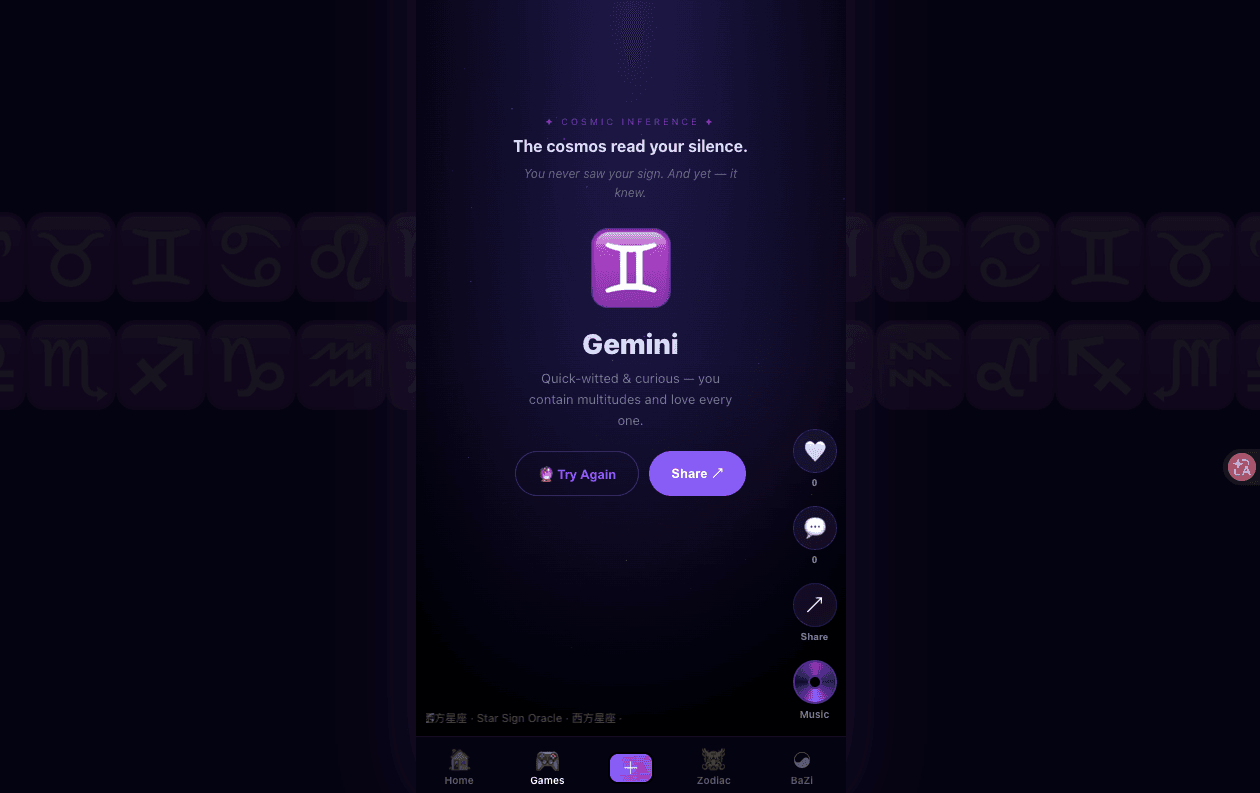
The Star Sign Oracle at ChineseFortuneTools.com implements Kimi’s 3-round structure. Pick your season. See one star sign card. Answer yes or no. See another if needed. If both are wrong, your sign materializes from starlight — the oracle “reads your silence” to find you.
The four inferred signs each get their own copy: Gemini hears “You contain multitudes — the cosmos tracked you through the gaps.” Pisces hears “The deep waters always hide the Pisces. The cosmos still found you.”
100% accurate. No birthday asked. Average under 3 questions.
What the Comparison Actually Reveals #
Six AIs. One problem. The spread was wider than I expected.
Grok optimized for mathematical completeness. Doubao optimized for provability. DeepSeek optimized for the best-case user. ChatGPT optimized for the emotional journey. Gemini found a 2-round solution that breaks the conventional constraint. Kimi proved the 3-round floor and designed the shareable moment into the structure.
No AI gave the same answer. All of them were correct in some sense. The right one depended on what you were building and why.
For a game that should feel like magic — the one where users share their result because it found them without ever showing them their sign — Kimi’s was the right structure. But I would not have seen it as clearly without running all six in parallel.
Try It
The game is live: Can I Guess Your Star Sign? — season question, two star cards, cosmic inference reveal. No birthday asked.