AI appears to have opened math research to a cohorts that weren’t typically expected to contribute meaningfully to the field until recently.
Two teenagers from Oak Park High School in California and a UCLA postdoc have just put their names on a research paper that’s making mathematicians sit up — because it appears to crack open a question that Fields Medalist June Huh had previously worked on without cracking himself.
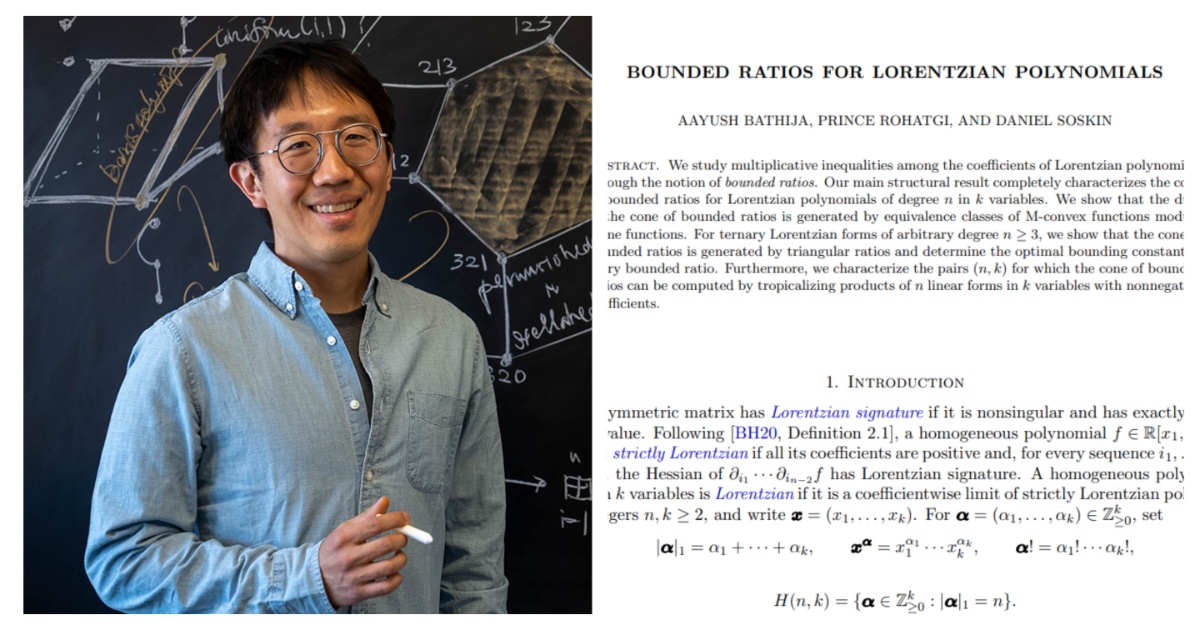
The paper, titled “Bounded ratios for Lorentzian polynomials,” was posted to arXiv by Aayush Bathija and Prince Rohatgi, both high schoolers, together with Daniel Soskin, a mathematics postdoc at UCLA. The trio worked together through the UCLA Math Circle, a weekend program where university mathematicians mentor promising younger students on real research problems. Word of the paper spread after UCLA professor Quanquan Gu posted about it online, noting that the work had been heavily AI-assisted and calling it a genuinely exciting example of high schoolers pushing into the frontier of mathematical research.
So what problem did they actually solve? #
The underlying mathematical question is about a very specific kind of “well-behaved” polynomial called a Lorentzian polynomial. These objects show up across combinatorics and geometry, and one of the basic things mathematicians want to know about them is: given the coefficients of such a polynomial, how much can one coefficient outweigh another? Put another way, if you know a few of the numbers that define the polynomial, how tightly can you pin down every possible ratio between any two of them?
Soskin had previously worked on a narrower version of this question — the case of “Lorentzian matrices,” essentially the simplest, quadratic version of the problem — alongside three more senior collaborators, one of whom was June Huh, who won the Fields Medal in 2022 for his work connecting combinatorics to algebraic geometry. That earlier paper pinned down the answer for the quadratic case but left the general question, for polynomials of any degree in any number of variables, open.
The new paper goes much further. Bathija, Rohatgi and Soskin give a complete description of the entire “cone” of possible bounded ratios for Lorentzian polynomials of any degree, in any number of variables — essentially a full map of which coefficient comparisons are always guaranteed to hold, no matter which specific Lorentzian polynomial you’re looking at. They show this cone can be described using a class of functions called M-convex functions, and for the specific case of three-variable (“ternary”) polynomials, they go a step further and work out the sharpest possible bounding constant for every one of these ratios — the tightest number that always holds true.
According to Gu, the paper leaned heavily on AI tools to get there, though the exact nature of that assistance — whether for searching the proof space, checking calculations, or something else — hasn’t been spelled out in detail. That detail matters less to most observers than the headline: two high schoolers working with a postdoc extended a research direction that stumped one of the most decorated living mathematicians, and did it with an AI in the loop.
Part of a much bigger story in 2026 #
This paper arrives in the middle of what’s become one of the most contentious storylines in mathematics this year: whether AI is actually advancing the field, or just producing a flood of correct-but-shallow results that senior mathematicians don’t quite trust.
The debate began sharply after an Anthropic researcher used the company’s Claude Fable model to disprove the decades-old Jacobian conjecture, a result that drew tens of millions of views online and got mathematicians across the world talking. Since then, AI labs have kept pushing into open problems, prompting a backlash from parts of the mathematical establishment — OpenAI was recently forced to pull its sponsorship of a Caltech “Mathathon” after mathematicians objected to the format, and just this month, 25 Fields Medal winners, including Terence Tao and June Huh himself, signed a joint declaration warning that the way AI companies are racing through famous open problems is doing real damage to the discipline.
Not every prominent mathematician is on that side of the argument, though. This year’s Fields Medal winner, Jacob Tsimerman, went the opposite direction and joined OpenAI outright, saying he expects AI to soon do everything working mathematicians do, only faster.
Against that backdrop, a paper from two high schoolers and a postdoc extending one of a Fields medalist’s own open questions is a small story with a fairly loaded punchline: even the person warning loudest about AI’s effect on his field is now watching AI-assisted teenagers build on his own unfinished work.